
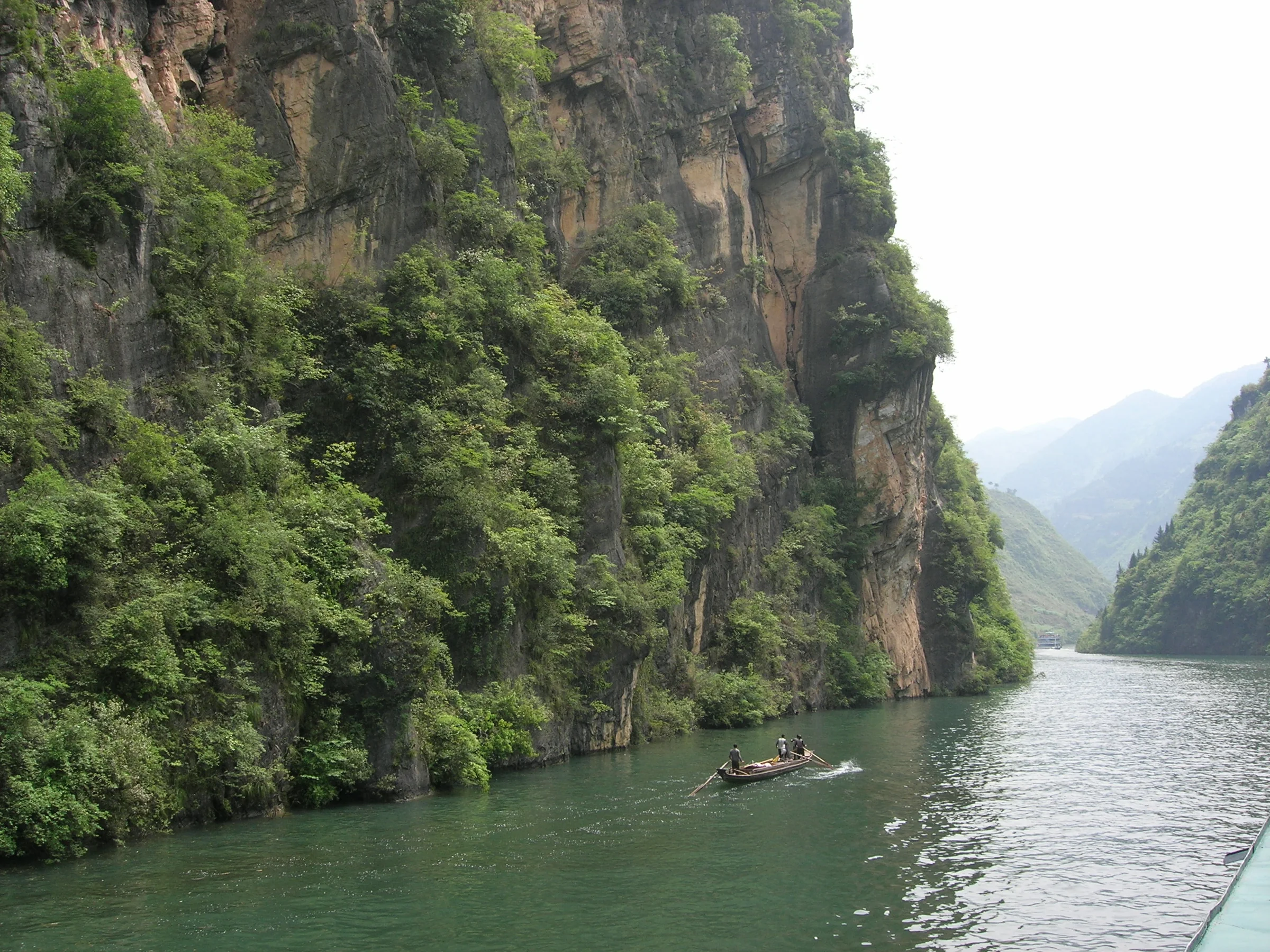

Cover image: The Lesser Three Gorges on 15 April 2006, photographed by Jacky Lee. This historical view does not establish current water level, craft, route or access. Creator: Jacky Lee; Source: Small three gorge 小三峡 - panoramio - Jacky Lee (1).jpg; License: CC BY 3.0; Changes: EXIF auto-orientation, proportional resizing and WebP conversion; full composition retained and EXIF removed. No crop, retouch, scene synthesis or watermark removal.
Wushan's Lesser Three Gorges in 2026 is a Daning River boat excursion, distinct from travelling through the main Yangtze Three Gorges. The municipal tourism description names Longmen, Bawu and Dicui as its three gorges. Before buying, confirm the actual route, whether a Madu River extension is included, and how the boat journey connects with your arrival.
Save 巫山小三峡 for the Lesser Three Gorges and 小小三峡 for the Mini Three Gorges. English names such as Small, Lesser and Mini can be used inconsistently on booking platforms. The river name and included route are more dependable identifiers than the adjective alone.
This is a desk-researched planning guide. It does not confirm a departure, berth, current fare or same-day water condition. The objective is to help you recognize what a seller is offering before you arrange a regional journey around it.
Put the three river scales in the right order
The municipal tourism introduction, visibly dated 11 June 2026, places the Lesser Three Gorges on the lower Daning River in Wushan. It separately places the Mini Three Gorges on the Madu River, a tributary of the Daning.
Think of three levels: the Yangtze journey, a Daning excursion, and a possible Madu extension. This relationship is more useful than trying to distinguish similar English product titles from memory. Ask the seller to mark the route names in Chinese if the translation is unclear.

The Little Three Gorges along the Daning River in Wushan, photographed by Chen Hualin on 9 August 2007. Keep this tributary setting separate from a generic Yangtze gorge photograph. Creator: Chen Hualin; Source: The Little Three Gorges along Daning river in Wushan,Chongqing.JPG; License: CC BY-SA 3.0; Changes: EXIF orientation handling and WebP conversion; full composition and original pixel dimensions retained; EXIF removed. No crop, retouch, scene synthesis or watermark removal. Adapted photographic material is offered under the same CC BY-SA version linked above.
The municipal page names Longmen, Bawu and Dicui for the Daning section, and Sancheng, Qinwang and Changtan for the Mini Gorges. You do not need to memorize all six before boarding. Keep the two sets separate so that a description of one is not mistaken for a promise to visit the other.
A destination page is also different from an itinerary. The Century Cruises description explains the tributary landscape and use of smaller passenger boats. Its presence on a cruise company's site does not establish that every sailing includes this excursion or follows an identical route.
Decide between a cruise excursion and an independent visit
For a multi-day cruise, begin with the itinerary attached to your own sailing. Is the Lesser Three Gorges excursion included, optional or absent? Is another tributary excursion named instead? The operator's destination index lists different gorge and stream destinations separately; a broad promise of “Three Gorges scenery” does not settle the question.
If the excursion is included, ask where you transfer, what you need to carry and when you must return to the main vessel. Follow the sailing's actual instructions rather than buying a duplicate independent ticket because an online listing looks similar.
For an independent visit, the boat trip starts with the required local meeting point, not with a view of the river from your hotel. Confirm the departure location, check-in procedure, expected return point and the transport between those places and your Wushan base or arrival terminal.
These are two different planning tasks. A cruise passenger is fitting an excursion into a managed voyage; an independent visitor is assembling the whole chain. Neither approach should borrow the other's transfer assumptions or treat the other product's price as a like-for-like comparison.
Read the ticket beyond the headline price
Ask the seller to identify four elements: the Daning route, any Madu extension, the required boat transfers and the included land transfer, if any. Then check whether the ticket is tied to a departure time, a check-in window or another dispatch arrangement.
Confirm what happens if the Madu component cannot operate while another part of the excursion proceeds. Is there a substitute, a partial refund or a different route? Read the conditions before paying rather than assuming that a combined product means every component is unconditional.
Travel-platform English can be particularly confusing here. The main Wushan listing identifies 巫山小三峡, while another product may emphasize the Mini Gorges but use a similar English name. Keep the Chinese label and route scope with your confirmation.
Ask whether any seating or deck area costs extra, whether commentary is included and what language is provided. No universal surcharge or English-guiding promise was verified for this article. A review describing what one passenger paid is not a tariff for your booking.
Finally, check cancellation terms and identity-document requirements. If you use a foreign passport, confirm that the chosen booking channel supports it rather than selecting an unsuitable document category to finish a form.
Treat the advertised duration as a planning estimate
The municipal overview describes a typical boat visit as about four hours. Use that as a broad expectation, not as a promised departure-to-return interval for every product. Check the actual estimate attached to your route and the conditions under which it might change.
Separate the day into three blocks: reaching and checking in at the departure point, the excursion itself, and leaving after disembarkation. Boat changes, queues or dispatch arrangements can sit outside a seller's headline sightseeing duration. Clarify what its estimate covers.
The same caution applies to distance. The municipal description gives an approximate 50-kilometre scenic extent, while the travel-platform page uses a different figure. Neither number should be used to calculate the kilometres you will sail, your speed or the time needed to catch an onward train.
For an independent journey, avoid an onward booking that works only if every step takes the shortest advertised time. For a cruise excursion, use the crew's current return instructions. If something is unclear, ask before leaving the main vessel or the excursion meeting point.
Prepare for boarding, transfers and time aboard
A scenic boat journey can involve more movement than the words “sit and enjoy the view” suggest. Before purchase, ask about the approach to the boat, gangways, steps, handrails and any transfer to another craft. The Century destination page establishes the smaller-boat context, but not a current accessibility specification.

A small-boat excursion identified by the photographer as 小小三峡, the Smaller or Mini Three Gorges, on 24 August 2014. This is historical craft context, not the vessel, equipment or boarding method promised by a current ticket. Creator: Yoshi Canopus; Source: Smaller Three Gorges Cruise.jpg; License: CC BY-SA 4.0; Changes: EXIF auto-orientation, proportional resizing and WebP conversion; full composition retained and EXIF removed. No crop, retouch, scene synthesis or watermark removal. Adapted photographic material is offered under the same CC BY-SA version linked above.
If someone has limited mobility, ask for information on the whole route and the particular vessels. A level quay at the first boarding point does not establish an accessible second boat or toilet. Explain the practical assistance needed and check whether it can actually be provided.
Keep one manageable bag with the items needed during the excursion. Ask about toilet availability, food, drinking water and luggage arrangements rather than assuming the facilities of a large overnight cruise ship will be available on every smaller craft.
Follow the crew's directions about seating, decks and safety equipment. Take photographs from permitted positions without blocking a gangway or leaning beyond a barrier. Secure loose belongings before moving between boats, and keep children with their responsible adult during boarding and transfers.
For comfort, prepare for the conditions forecast on your date rather than a fixed image of the gorge. A bright summer promotional photograph is not a guide to the clothing needed for a cooler or wet departure.
Look at the landscape without expecting every brochure scene
The municipal description discusses steep banks, vegetation and historical remains, including cliff coffins. Choose two things to notice: how the visible river corridor changes as the boat moves, and how human traces relate to the landscape. You do not need to identify every named rock shape to have an attentive visit.
Some names are interpretive or folkloric. A guide may describe a rock as resembling a person or animal; that is a way of looking, not a claim that every passenger will see the same outline. If a historical feature is pointed out, ask which visible element is the feature and what is known about it.
Do not expect wildlife, mist, clear green water or waterfalls on demand. Photos record a particular date and conditions. Historic images also require caution when comparing river levels, shoreline structures and routes with the present landscape.

A Daning River excursion boat in the Lesser Three Gorges in 1996; the source records the year only. This older photograph demonstrates why past craft and shoreline scenes cannot describe present-day boarding, river levels or safety arrangements. Creator: G41rn8; Source: China 1996 97.jpg; License: CC BY-SA 4.0; Changes: EXIF orientation handling and WebP conversion; full composition and original pixel dimensions retained; EXIF removed. No crop, retouch, scene synthesis or watermark removal. Adapted photographic material is offered under the same CC BY-SA version linked above.
Avoid feeding wildlife or asking a boat to approach a sensitive feature for a photograph. The excursion route and permitted viewpoints belong to the operator's current instructions. A zoomed image in a travel article is not evidence that a visitor may climb to the place shown.
A short personal note can preserve more than a long list of photographs: one view you noticed, one explanation you learned and one question you still have. That keeps the experience grounded in what you actually encountered.
Be realistic about the shared-boat experience
A public review on the Trip.com Wushan page describes a boat change and unwanted sales pitches during that visitor's trip. It is an individual report, not proof that every departure follows the same pattern. Its value is in identifying expectations worth checking.
If commentary, sales activity or seating matters to you, ask the seller about the actual product. A scenic photograph tells you little about the sound level aboard, the language of announcements or how passengers share deck space. A smaller vessel does not necessarily mean a private or silent experience.
You can decline an optional purchase without needing to debate its quality. Before agreeing to photographs, souvenirs or an upgrade, ask the total price and what you receive. Do not confuse a sales presentation with a requirement to participate.
For a group with different interests, agree on two priorities before boarding: the landscape and the practical comfort needed to enjoy it. Chasing a particular seat or spending the whole trip comparing a real view with edited images can distract from both.
Check operation and the Wushan connection together
Confirm the selected sailing close to your travel date, especially if weather or water conditions have changed. A general destination page is not an operational notice. An older account of a cancelled Mini Gorges visit is not evidence that the route is closed now either.
Ask what information channel the operator uses for changes and whether it will contact the booking holder. Keep the seller's details and the booking reference available offline. If a component is cancelled, follow the agreed process rather than finding an unofficial boat to recreate the itinerary.
For arriving in Wushan, verify the actual station or terminal and its local connection. Our railway-stations guide explains why the exact names matter; no current Wushan shuttle schedule or transfer time was verified for this article.
Use a named meeting point and a confirmed pin, following the method in our navigation guide. For a car transfer, establish whether the return pickup is included and how a changed boat arrival is handled. Our taxi and ride-hailing guide provides general context without guaranteeing local vehicle availability.

Daninghe River Bridge near Wushan on 10 August 2009, with construction equipment visible. This historical river-setting image is not a current departure-point or transport-access diagram. Creator: Putneymark; Source: Three little gorges 10.jpg; License: CC BY-SA 2.0; Changes: EXIF auto-orientation, proportional resizing and WebP conversion; full composition retained and EXIF removed. No crop, retouch, scene synthesis or watermark removal. Adapted photographic material is offered under the same CC BY-SA version linked above.
About This Guide
Sources read on 1 October 2026 include the municipal tourism introduction, Century Cruises' destination material and public Trip.com content. An older Century-hosted travelogue was checked but excluded from current operational claims. The route distinctions are source-based; planning choices are editorial advice. No firsthand sailing, live departure confirmation or vessel accessibility assessment is claimed.
Frequently Asked Questions
Q: Is the Lesser Three Gorges trip the same as a Yangtze cruise? A: No. The Lesser Three Gorges is a Daning River excursion in Wushan. A Yangtze cruise may include or offer it, but the itinerary for your particular sailing determines that.
Q: Are the Mini Three Gorges on the same river? A: The municipal description places the Mini Three Gorges on the Madu River, a tributary of the Daning. Confirm whether that component and any boat transfer are included in your product.
Q: How long should I allow? A: The municipal overview describes a typical boat visit as about four hours. Check your product's estimate and allow separately for check-in, transfers and the onward journey.
Q: Can I assume a boat change is step-free? A: No. Ask about the particular vessels, boarding points, steps, toilets and assistance for the complete Wushan excursion before buying.
Q: Does the ticket include every deck, guide and transfer? A: Inclusions depend on the product. Have the seller itemize the route, seating, commentary, boat changes and any land transfer rather than relying on the broad Lesser Three Gorges name.
Traveler comments
Share a recent experience or ask a practical question about this guide.