
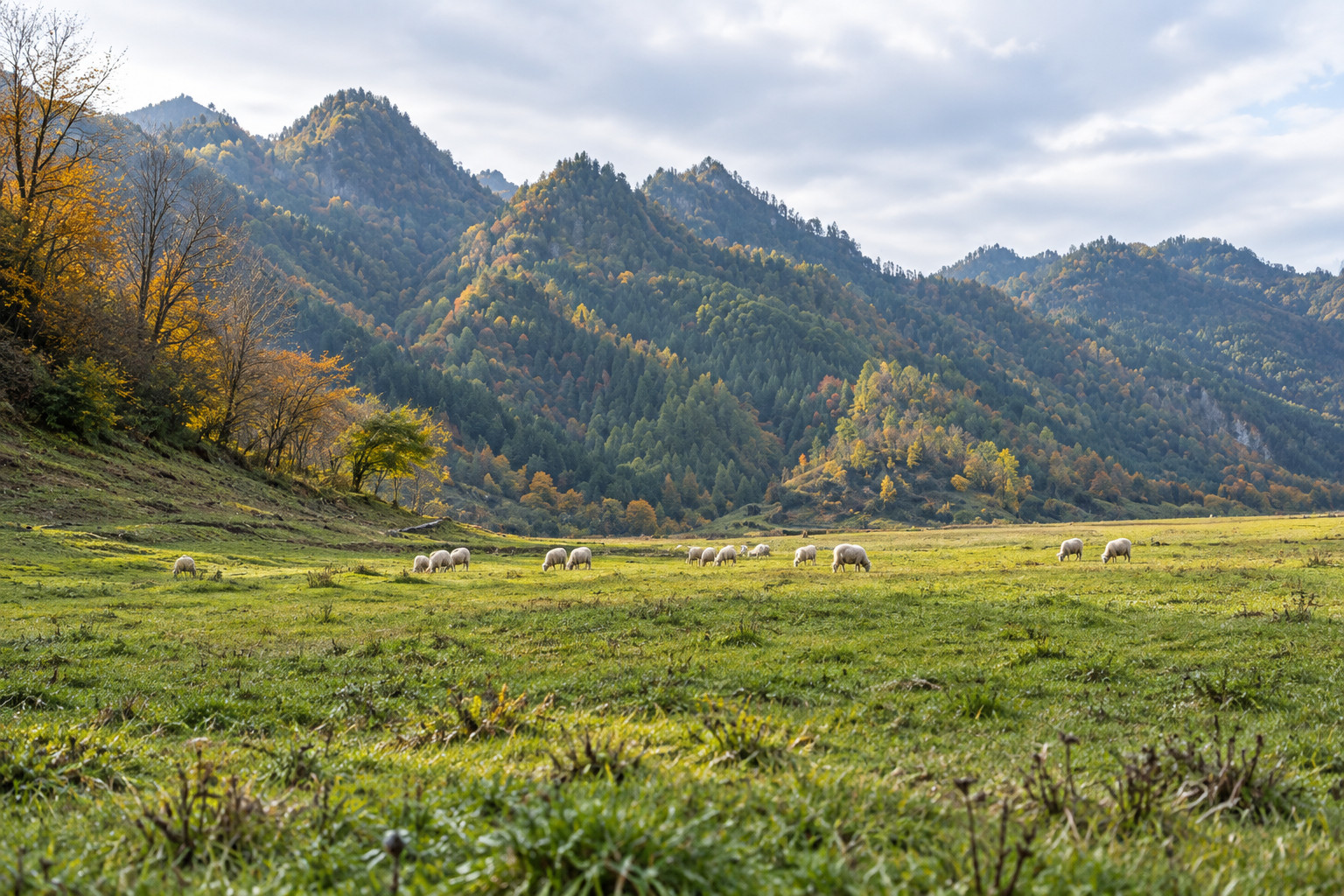
Cover illustration: AI illustration based on a historical photograph. Hongchiba meadow, small grazing sheep and enclosing wooded ridges; current meadow conditions are unverified. Scene, terrain and architectural details are approximate; not a current photograph, access confirmation or navigation guide.
Historical reference only; original photograph not republished or licensed for reuse: iChongqing / Bridging News / SiPing Liu
This guide contains four explicitly labeled AI scene illustrations from historical photo references and one original localized planning diagram. Photograph capture dates and current access are not established by the page update dates. No independent review is claimed.
Hongchiba in Wuxi County is a highland meadow and forest destination to plan cautiously in 2026. Chongqing's forestry description places it between 1,800 and 2,630 metres above sea level. An overnight trip with confirmed road access and lodging is a more useful starting point than promises of flowers, snow or a fixed sightseeing circuit.
Save 巫溪县红池坝 and the exact address of your intended accommodation. Wuxi here is the county in Chongqing, written 巫溪; do not confuse it with 无锡 in Jiangsu. The shared English spelling makes retaining the Chinese name especially useful when searching or arranging transport.
This guide focuses on choosing the season, understanding the landscape and making a workable remote stay. It does not claim an editorial visit, a surveyed hiking route or current road inspection. Access, tickets, internal transport and accommodation availability must be checked for your actual dates.
Understand the scale without collecting every landmark
The municipal forestry description published in June 2026 places Hongchiba in western Wuxi County and describes a landscape of forest, grassland and high ground. It identifies the national forest park and its 4A scenic-area status. This is a regional mountain destination, not a park beside central Chongqing's urban sightseeing route.
Different published area figures refer to different descriptions of Hongchiba. The 2023–2035 scenic-area planning approval covers a broader 449.94-square-kilometre planning area, divided into six zones. A planning boundary is not the same thing as a visitor circuit or a promise that each zone can be entered.
For your own itinerary, choose one main landscape interest and identify the actual open place that serves it. A view of meadow, an identified flower display and a forest setting need not all be treated as separate obligations. Ask the operator which areas can realistically be combined using the current internal transport arrangements and your group's walking abilities.
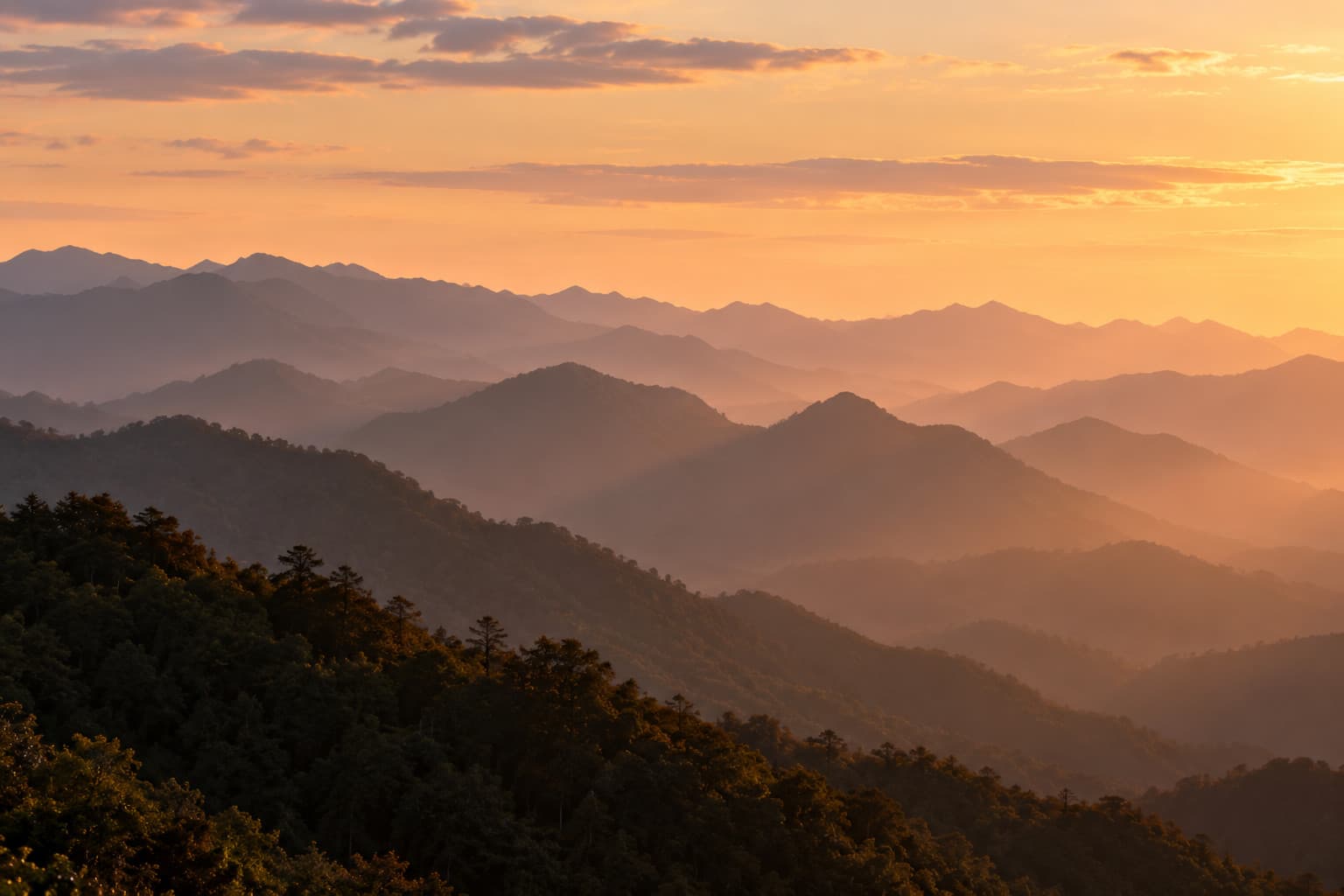
AI illustration based on a historical photograph. Hongchiba mountain layers in low light; no named viewpoint or guaranteed sunset is established. Scene, terrain and architectural details are approximate; not a current photograph, access confirmation or navigation guide.
Historical reference only; original photograph not republished or licensed for reuse: iChongqing / Bridging News / ChaoLin Li
Decide what you want from the season
The 2026 forestry page reports a summer average around 17°C. This helps explain Hongchiba's appeal as a highland retreat, but it does not forecast an individual day. Exposure, rain and the difference between daytime and overnight conditions still matter to the trip you book.
Choose between three different priorities. If you mainly want a meadow-and-forest stay, you can be flexible about the exact appearance of vegetation. If a particular flower display is essential, you need recent confirmation of that display at a named location. If snow is the goal, you also need confirmation that the approach and visitor areas are open under the expected conditions.
Autumn can bring a different palette. An undated iChongqing feature depicts yellow larch woodland, but its references to “this July” and “this October” have no visible publication year on the opened page. They cannot establish a 2026 reopening date or a precise colour-viewing window.
Ask for a recent dated photograph if seasonal appearance will determine whether you travel. A useful response identifies the place and date, rather than forwarding a promotional collage containing several seasons. Then decide whether the underlying landscape would still satisfy you if the preferred flowers or colours were less developed.
Read the flower fields as part of a managed landscape
The Chongqing Local Chronicles Office's June 2026 account records large-scale introduction of alpine flowers in 2011. This is an important corrective to a common photographic assumption: a broad colourful display should not automatically be described as an untouched field of wildflowers.
Xinhua's summer photo essay, published on 12 August 2022, identifies pictures taken two days earlier in the Yunzhong flower area. The essay establishes what its photographer documented then. It does not confirm this year's planting, bloom condition, entrance arrangement or available activities.
A rewarding visit can consider both cultivation and setting. Look from the permitted path at how planted colour relates to the surrounding meadow, trees and slope. Ask which flowers have been planted and whether the display changes through the season. Treat the answer as information about that location, not a rule for every field in the wider area.
Stay out of planting beds even if another visitor has flattened a route through them. A close photograph is not worth damaging the subject. If the display is past its peak, work with its actual appearance or choose a wider landscape composition instead of expecting staff to reproduce a brochure image.
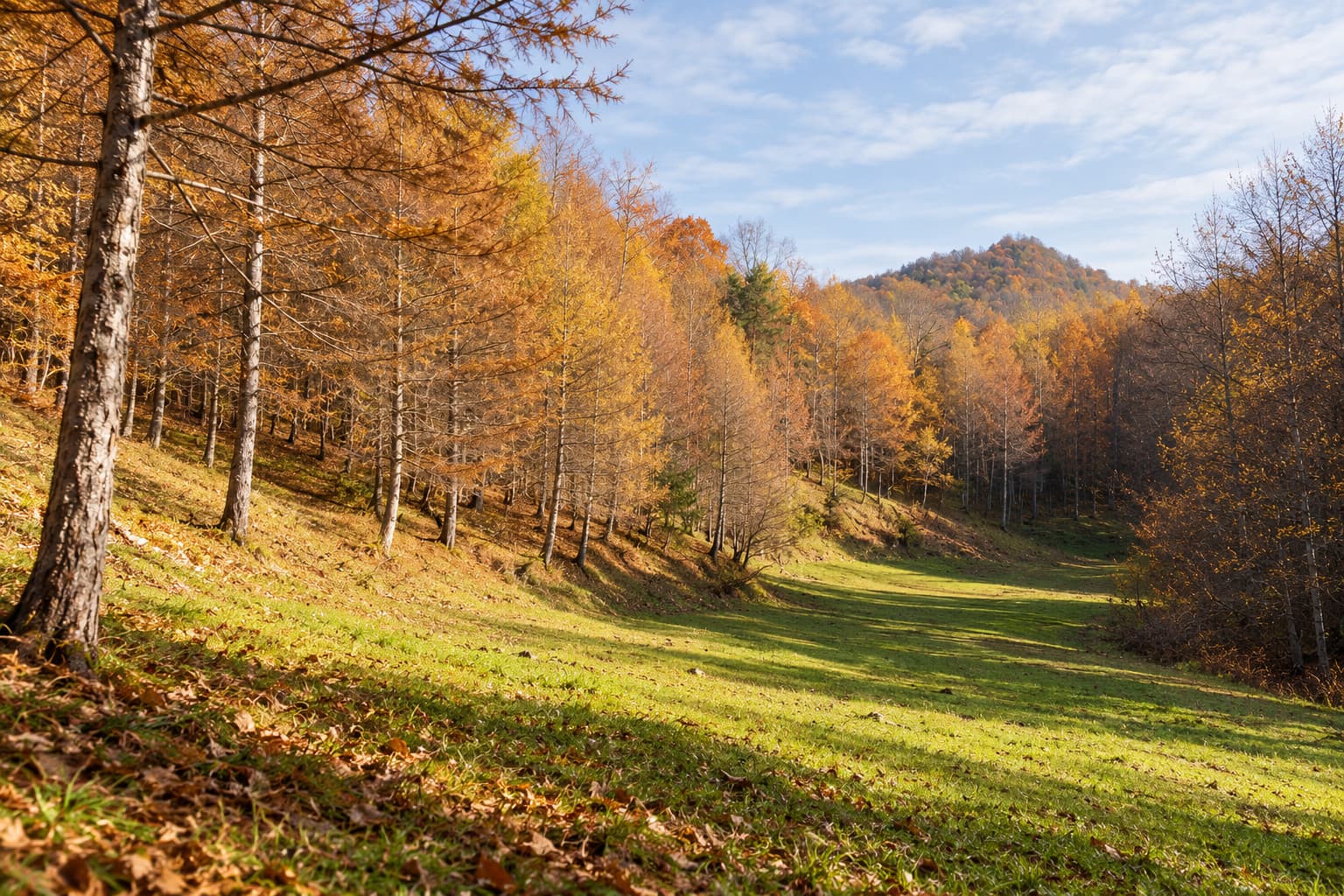
AI illustration based on a historical photograph. Hongchiba autumn woodland and grassy hollow; seasonal colour is illustrative, not a current foliage report. Scene, terrain and architectural details are approximate; not a current photograph, access confirmation or navigation guide.
Historical reference only; original photograph not republished or licensed for reuse: iChongqing / Bridging News / QingHua Tang
Make the road connection the first booking check
The official 2026 description situates Hongchiba well beyond the metropolitan core. This guide deliberately does not convert a published distance into a promised driving time. Road conditions, the chosen approach and your precise lodging address affect the journey.
Start with the complete transport chain. Where will you arrive in the region? Which provider will take you to the actual property or entrance? Where and when will the return pickup occur? Check those three points before booking a room that would otherwise be difficult to reach.
If relying on a private transfer, agree on the destination, vehicle, total charge, waiting arrangement and any separate entrance or internal transport costs. Ask what happens if weather or a closure prevents the planned approach. A driver agreeing to take you to Wuxi county town is not the same arrangement as delivery to a particular Hongchiba property.
If driving, confirm the current recommended approach with the operator and use current navigation. Do not select an unfamiliar mountain shortcut solely because it appears shorter. Plan the first arrival in daylight where practical, keep a usable offline address and leave enough margin to stop safely. The regional navigation guide explains why exact place pins are more useful than English names alone.
Choose lodging for a weather-dependent stay
The 2023 planning approval discusses the staged provision of tourism infrastructure. Planned accommodation and services should therefore not be treated as completed bookable facilities. Before paying, verify the exact operating property rather than selecting a development with Hongchiba in its name.
For a first trip, an overnight stay is a practical editorial recommendation if it makes the journey less rushed. It is not a claim that every traveler needs precisely two days. The right length depends on the approach, open routes and whether you will enjoy time at the accommodation if the weather changes.
Ask about heating, hot water, meals, the last practical arrival time and the distance between the vehicle drop-off and your room. Request specific information about steps if anyone in the party has mobility limitations. Confirm whether food must be ordered in advance and whether there are alternatives when a promised meal service is unavailable.
A flexible booking can matter more than a scenic room photograph. Read the cancellation terms and establish what happens if access is interrupted. Bring the small personal supplies you cannot readily substitute, and avoid assuming that every nearby service runs throughout the year.
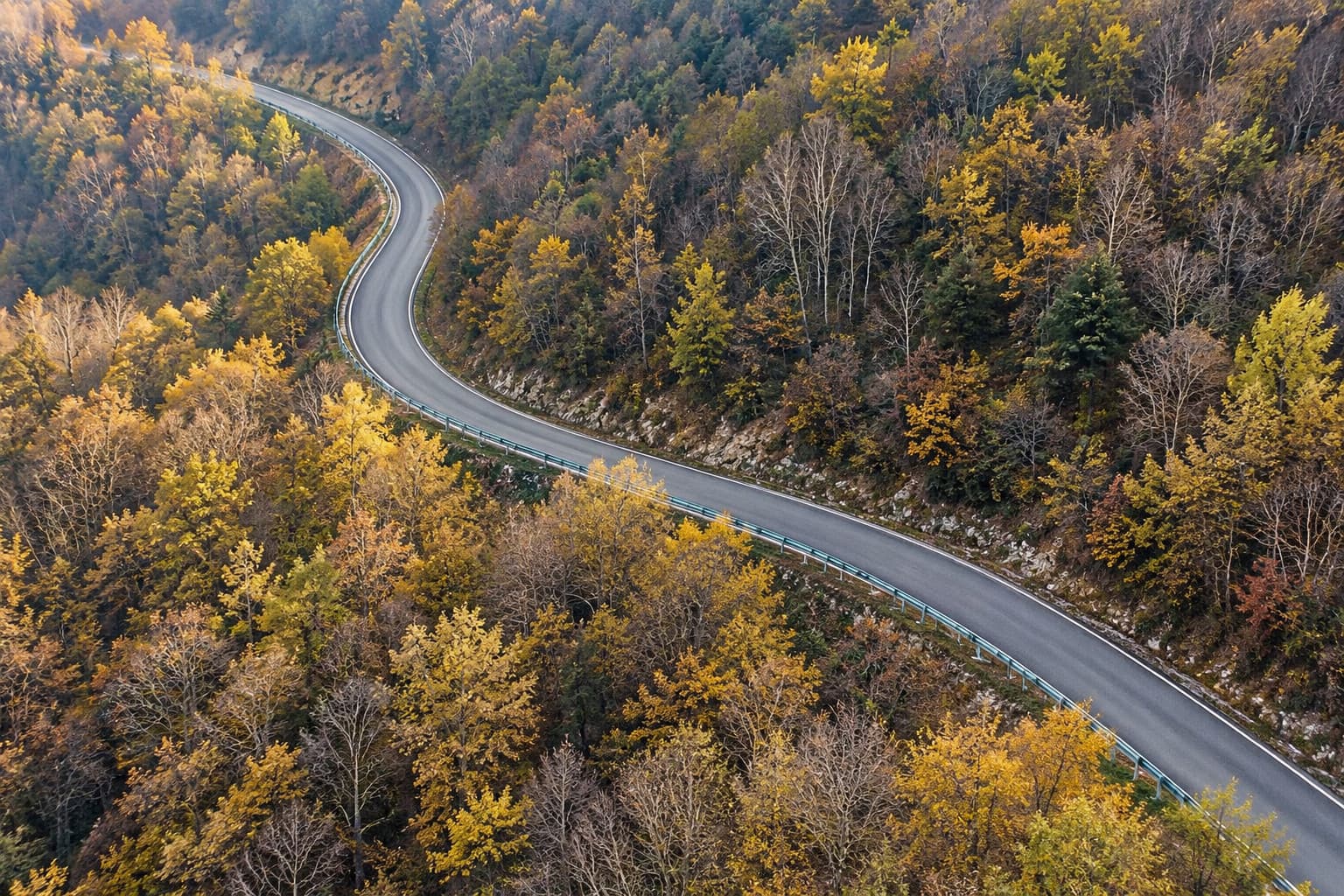
AI illustration based on a historical photograph. A winding Hongchiba forest road; the image does not verify present road condition or opening. Scene, terrain and architectural details are approximate; not a current photograph, access confirmation or navigation guide.
Historical reference only; original photograph not republished or licensed for reuse: iChongqing / Bridging News / ZiJu Xiang
Treat snow and frost as conditions, not attractions on demand
A China Daily report from 8 November 2019 documents rime at Hongchiba, with photographs credited to Peng Cheng. That is a dated weather event. It is evidence of a possible landscape appearance, not an annual appointment or confirmation that a winter visit can proceed safely.
Before a cold-season trip, obtain a current answer about the approach road, entrance status, open visitor areas and the transport provider's willingness to travel. Also check the property's heating and meal service. If those answers are missing, a snow photograph is not enough reason to commit to the journey.
Do not infer that a named ski, ice or snow project is operating from a planning announcement or construction report. A bookable activity needs its own current operator information, conditions and appropriate equipment arrangements. This guide does not confirm a functioning ski product.
Keep the choice to postpone real. A tight onward connection or inflexible room reservation can pressure a group into continuing when access has changed. Arrange the trip so a weather cancellation is inconvenient rather than a reason to ignore closure signs or ask a driver to attempt an unsuitable route.
Follow current boundaries around meadows and water
The scenic-area plan explicitly distinguishes conservation zones. Its existence is a reminder that the apparent openness of a meadow does not grant unrestricted movement, camping or vehicle access. Ask staff which public paths and activity areas are open during your visit.
Older material shows horses and camping at Hongchiba. The 2022 Xinhua photographs should be understood as historical reporting, not current permission to pitch a tent or approach livestock. Book any activity through its presently authorized operator and clarify its safety requirements independently of the general entrance ticket.
For a simple landscape visit, there is no need to leave the managed route. Do not drive onto grass for a photograph, collect plants, enter livestock enclosures or step toward water because a picture shows someone doing so. Keep food away from animals and remove your litter.
Agree on a clear meeting point and a turnaround decision before separating for photographs. In cloud or poor visibility, a distant tree or an unnamed hillside may cease to be a useful landmark. A shorter, permitted outing is preferable to improvising across unfamiliar ground.
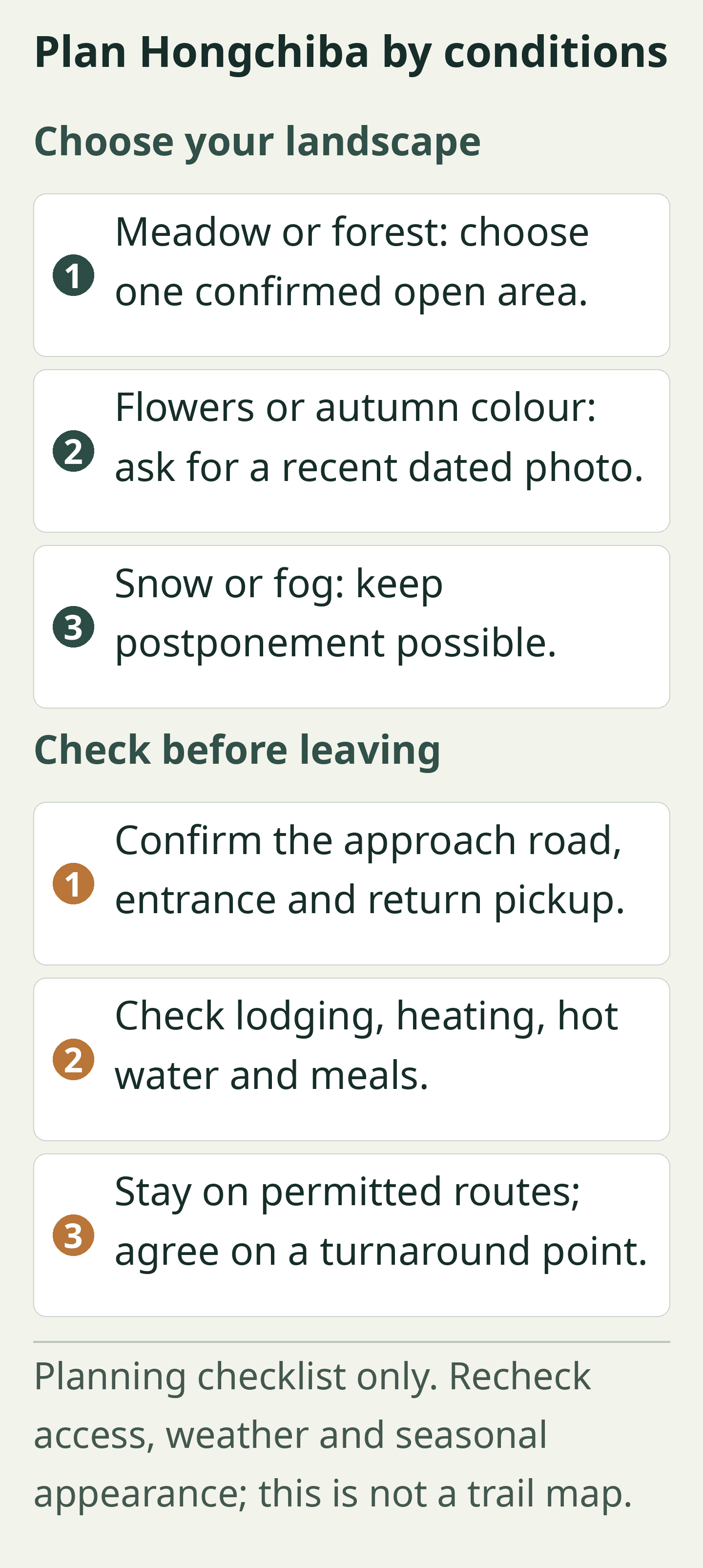
Original planning card; all labels also appear as selectable text below. Planning checklist only. Recheck access, weather and seasonal appearance; this is not a trail map.
Original editorial planning diagram based on this article; not a photograph or geographic map.
Plan Hongchiba by conditions
Choose your landscape:
- Meadow or forest: choose one confirmed open area.
- Flowers or autumn colour: ask for a recent dated photo.
- Snow or fog: keep postponement possible.
Check before leaving:
- Confirm the approach road, entrance and return pickup.
- Check lodging, heating, hot water and meals.
- Stay on permitted routes; agree on a turnaround point.
Planning checklist only. Recheck access, weather and seasonal appearance; this is not a trail map.
About This Guide
Six topic-specific pages across four root domains were read on 1 October 2026. Official sources establish the destination and planning context; the dated photo reports help distinguish seasonal possibilities from present conditions. No on-site inspection, fresh independent traveler report or current service timetable is claimed.
Use the railway-stations guide for preparing any regional rail leg and the foreign-passport hotel guide for lodging questions. Neither confirms a Hongchiba transfer or property. Recheck the chosen entrance, road access, lodging, meals and return before the trip; leave flower, frost and cloud expectations flexible.
Frequently Asked Questions
Q: Where is Hongchiba? A: Hongchiba is in Wuxi County, Chongqing, written 巫溪县红池坝. Keep the Chinese name when searching because Wuxi in Jiangsu is a different city.
Q: Is Hongchiba suitable for a quick Chongqing city outing? A: Hongchiba is a regional highland destination, so assess the complete road connection before treating it as a day trip. An overnight stay is suggested when it gives you useful landscape time without a rushed return.
Q: When will the Hongchiba flowers be at their peak? A: This research did not verify a fixed 2026 flowering window. Ask for recent dated information from the specific flower area, and distinguish managed planting displays from wild vegetation.
Q: Does a winter photograph mean the roads and attractions are open? A: No. Hongchiba's snow and rime photographs record conditions at particular times; current access, lodging and any winter activity require separate confirmation.
Q: Can I camp anywhere on the meadow? A: Do not assume so. Confirm an authorized operating camping area and its current rules; Hongchiba's conservation landscape and historical camping photos do not create unrestricted access.

Traveler comments
Share a recent experience or ask a practical question about this guide.