
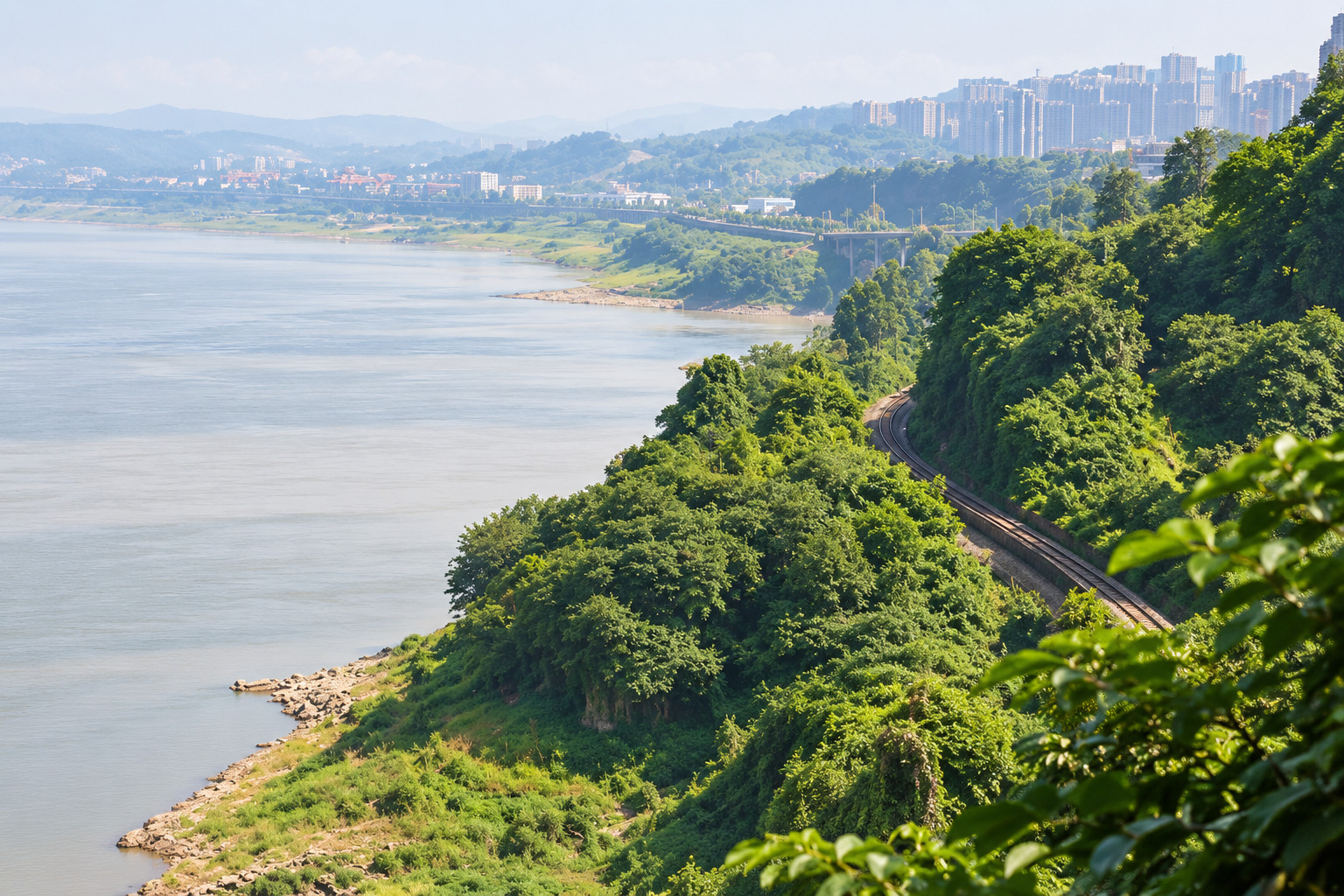
Cover illustration: AI illustration based on historical photographs; scene and details are approximate. A wide Yangtze view with water on the left, a densely vegetated cliff and curving railway on the right, and a distant skyline; no train is shown. These references were published in 2019, before the town reopened in September 2026. They do not show the reopened town, current bus stops, open routes or museum admission.
Historical photo reference only; original not republished; the reference grants no reuse permission: Sina / 乡王子 (Source article author; photographer not separately credited)
These references were published in 2019, before the town reopened in September 2026. They do not show the reopened town, current bus stops, open routes or museum admission.
Yidu Park in 2026 is a Dadukou outing for garden paths, cliff-edge landscape and an optional visit to the neighboring riverside town. Chongqing's local-history office identifies the park beside Yidu Ancient Town. A new 483 feeder service improves the approach, while September's town reopening makes older descriptions of the area incomplete.
Use 义渡公园 for the park and 义渡古镇 for the adjacent town. They belong in the same geographical conversation but are not interchangeable destinations. The park is the landscape-focused part of this guide; the town adds streets, businesses and potentially events, with its own operating arrangements.
Come for a slow look at the way Chongqing's river, slopes and settled districts meet. If you mainly want an industrial-history exhibition, choose and verify that museum separately. A park walk cannot substitute for an indoor collection, and a museum booking does not establish an easy walking connection through every neighboring space.
Recognize the park, the town and the wider cliff-line setting
The Chongqing local-history office's account of 24 August 2026 describes Yidu Park as a classical-style garden along the cliff line next to Yidu Ancient Town. It explains that the town was restored and rebuilt on the former Masangxi settlement's site. Use that distinction when comparing a historic story with the buildings or landscaping visible today.
The setting rewards attention to levels. A view toward the river may not imply direct access to the water, while a path on a lower level may not connect to the entrance you used. Read the local map as a network of signed routes rather than a flat collection of nearby pins.
A useful approach is to identify the park entrance, the main public path and a comfortable viewpoint before adding anything else. Study the river-facing landscape from designated spaces, then decide whether the town fits the same outing. You do not need to reach the lowest possible point to appreciate the relationship between the bank and the cliff.
This also helps avoid confusing names. Masangxi may appear in historical accounts and mapping, while current event material uses Yidu. Show the full Chinese destination to a driver or staff member, including whether you mean the park entrance or the ancient town, instead of relying on an English translation alone.

AI illustration based on historical photographs; scene and details are approximate. A close view of a Masangxi Bridge pylon on the right, cables fanning left and the deck crossing diagonally over the river. These references were published in 2019, before the town reopened in September 2026. They do not show the reopened town, current bus stops, open routes or museum admission.
Historical photo reference only; original not republished; the reference grants no reuse permission: Sina / 乡王子 (Source article author; photographer not separately credited)
Recheck the approach around the new 483 feeder
A Chongqing Daily report dated 4 August 2026, carrying district reporting, describes a 483 short-working service that opened on 30 July. Its five stops run from Jianqiao Avenue West through the Jianqiao rail stop and Tongqiao Road to Xiqiao Road–Yidu Ancient Town, beside the park entrance. That is more useful than automatically following an old walking-only recommendation.
The report gives a reference fare of RMB2 and service from 07:00 to 19:30, while explicitly saying timings were still being adjusted. Treat that as the arrangement reported in August, not a confirmed October departure board. Check the actual stop name, direction and short-working designation before boarding; a route number by itself does not describe every service pattern.
Save 锡桥路·义渡古镇 as the reported destination stop and ask whether the bus you are considering serves it. If using rail for the larger journey, plan the connection to 轨道建桥站 in your current route app. The app should also help establish which exit and pedestrian approach are usable that day.
If the feeder is unavailable, compare a local taxi with walking after looking at the actual elevation and crossings. Do not let a short straight-line distance decide for a stroller, wheelchair or tired traveler. Our maps and road-levels guide explains the kind of level mismatch that can make a seemingly simple final leg awkward.

AI illustration based on historical photographs; scene and details are approximate. The white angular, asymmetric exterior of Guo Xuanchang Sculpture Art Museum, with blue glazing on the right and foreground foliage on the left. These references were published in 2019, before the town reopened in September 2026. They do not show the reopened town, current bus stops, open routes or museum admission.
Historical photo reference only; original not republished; the reference grants no reuse permission: Sina / 乡王子 (Source article author; photographer not separately credited)
Keep the park walk manageable while the area evolves
The Dadukou government's report published on 9 May 2026 records Yidu Park upgrades in its review of 2025. This is evidence that the landscape has been maintained and changed. It is not a certificate that every connecting path, toilet or viewpoint is open or step-free on your travel date.
At the entrance, inspect a visitor map or ask about the current main walking route. Find a bench or rest area, a toilet if needed and the way back before following a tempting downhill branch. A route that is easy while descending can be demanding on the return, especially if the alternative exit has no convenient transport.
Start with the section that matches the least mobile person in the group. Let additional walking be optional. If some people want to explore farther, agree on a recognizable meeting point rather than “somewhere near the river,” and ensure the group can communicate without relying on someone else's phone.
For wheelchair and stroller users, ask about continuous access between the selected entrance, viewpoint, toilet and pickup location. A single ramp or broad paved area does not establish that chain. It is reasonable to shorten the visit to a verified accessible section, provided that section offers enough interest to justify the journey.
On wet days, avoid narrow shortcuts, steep edges and polished surfaces where footing looks uncertain. Follow temporary barriers even if a photograph or an old route description shows people beyond them. A current closure can be local and brief; it still takes priority over the attractive view you came to see.
Treat the September town reopening as a separate, dated addition
The official local-news report of 26 September 2026 says Yidu Ancient Town reopened on 25 September after work on its appearance, businesses and facilities. It announced a holiday carnival through 7 October, with activities from 10:00 to 22:00. These were plans for the neighboring town, not the opening hours of Yidu Park or its buses.
That difference matters if you are visiting during the current holiday. A daytime garden walk might lead naturally into a town visit, but an evening event can require a different transport plan. Confirm the current program and where it takes place; do not assume an event listed for Renyi Street is occurring throughout the park.
Outside the announced period, remove the carnival from your expectations. A town can remain visitable after a festival without preserving the same food stalls, performances or decorations. Likewise, an opening ceremony proves that the ceremony occurred, not that every business shown in a promotional image will be open when you arrive.
The historical interest is still there, but ask what you are looking at. A reconstructed frontage, contemporary shop and historical lane can coexist. Enjoy the street scene without presenting a newly restored surface as untouched evidence of an earlier century. Before entering a business or photographing an artisan, establish whether it is public, commercial or private space.

AI illustration based on historical photographs; scene and details are approximate. A close diagonal view of a traditional-style timber-and-eaves lane in historical Masangxi town beneath the high bridge deck; part of a bridge pylon appears on the right. These references were published in 2019, before the town reopened in September 2026. They do not show the reopened town, current bus stops, open routes or museum admission.
Historical photo reference only; original not republished; the reference grants no reuse permission: Sina / 乡王子 (Source article author; photographer not separately credited)
Share the garden and river viewpoints considerately
The 24 August 2026 local-history account places the rebuilt town in a riverside, hillside setting with three streets and nine lanes. The surrounding public spaces are places people use, not a reserved photography set. Choose an open viewpoint where your group can stop without blocking a path or entrance.
Keep tripods and bags out of the walking line. Ask before making a recognizable person the subject of a portrait, particularly around homes, games or informal gatherings. Photographing the garden's design does not require including a child's face or turning someone's ordinary afternoon into your travel content.
Treat water as a landscape feature to observe from permitted areas. Do not climb railings, descend unmarked banks or assume a visible foreshore is a public route. A quiet-looking patch of river does not tell you about current, changing level or safe access. For children, decide who is supervising at viewpoints before everyone starts taking photographs.
A small picnic may sound like a natural park activity, but the permission for a particular lawn, tent, cooking device or amplified music should come from current local rules. Use a designated seating area, contain litter and keep food away from plants and wildlife. If a space is marked for rest or planting, respect that purpose even when it would make a convenient shortcut.
The Chongqing family-trip guide can help you balance a park visit with children's rest needs. Here, the important decision is to preserve a comfortable shared experience rather than maximize the number of stops.
Leave on the transport plan you checked, not the event's closing time
The August feeder report lists 19:30 as its reported end of service. The September town announcement's 22:00 event finish is a different piece of information. Do not infer that the bus, onward rail connection or convenient taxi pickup remains available until an activity finishes.
Before extending a visit into the evening, check the current departure in the direction you need and the journey beyond it. A return to a rail station is useful only if the onward service still works. A direct taxi may be practical, but confirm where vehicles can collect passengers if event crowds or traffic management affect the street.
Keep a recognizable exit as your fallback. If the group has split up, reunite before moving between the park and the town; searching for someone across several levels becomes less pleasant as daylight fades. Save the accommodation address in Chinese and keep enough battery for navigation and communication.
Avoid adding another riverside park at the end merely because it shares the same district. Enjoying Yidu at a reasonable pace is already a complete outing. Use the Chongqing taxi and ride-hailing guide for preparation, then let the actual evening conditions decide the final journey.

Original visitor-planning card; all labels also appear as selectable text below. Planning checklist, not a route map or access audit. Check current park, town and transport notices separately.
Original editorial planning diagram based on this article; not a photograph or geographic map.
Plan a Yidu Park visit
Plan the visit:
- Keep park and town plans separate
- Use signed paths and viewpoints
- Plan the climb back before going
Check before setting off:
- Which routes are open today?
- Are there steps on your route?
- When is the last ride home?
Planning checklist, not a route map or access audit. Check current park, town and transport notices separately.
About This Guide
Research took place on 1 October 2026 UTC. Sources include Dadukou government reporting, Chongqing's local-history office, district transport reporting carried by Chongqing Daily and the September reopening report. This is not a firsthand walk or an accessibility audit. Suggested choices are editorial advice, and dated announcements require checking against the current park, transport and event notices.
Frequently Asked Questions
Q: Is Yidu Park the same place as Yidu Ancient Town? A: No. Yidu Park, 义渡公园, is the neighboring garden and cliff-line landscape; Yidu Ancient Town, 义渡古镇, is the restored riverside street area.
Q: Is there a bus to Yidu Park? A: An August 2026 district report describes the 483 short-working service to Xiqiao Road–Yidu Ancient Town beside Yidu Park's entrance. Confirm its present timetable and direction before traveling.
Q: Does Yidu Park's bus run until the holiday events finish? A: Do not assume so. The August report listed a 19:30 bus finish, while the adjacent Yidu Ancient Town carnival was announced until 22:00; these are different schedules.
Q: Is Yidu Park suitable for a wheelchair or stroller? A: Verify a continuous route through the chosen part of Yidu Park, including the entrance, toilet and exit. The cliff-line setting means a broad path in a photograph cannot establish whole-route accessibility.
Q: Can I still expect the Yidu Ancient Town carnival after 7 October 2026? A: The announcement covered the period through 7 October. Check later Yidu notices for subsequent events rather than carrying the holiday program forward.


Traveler comments
Share a recent experience or ask a practical question about this guide.