
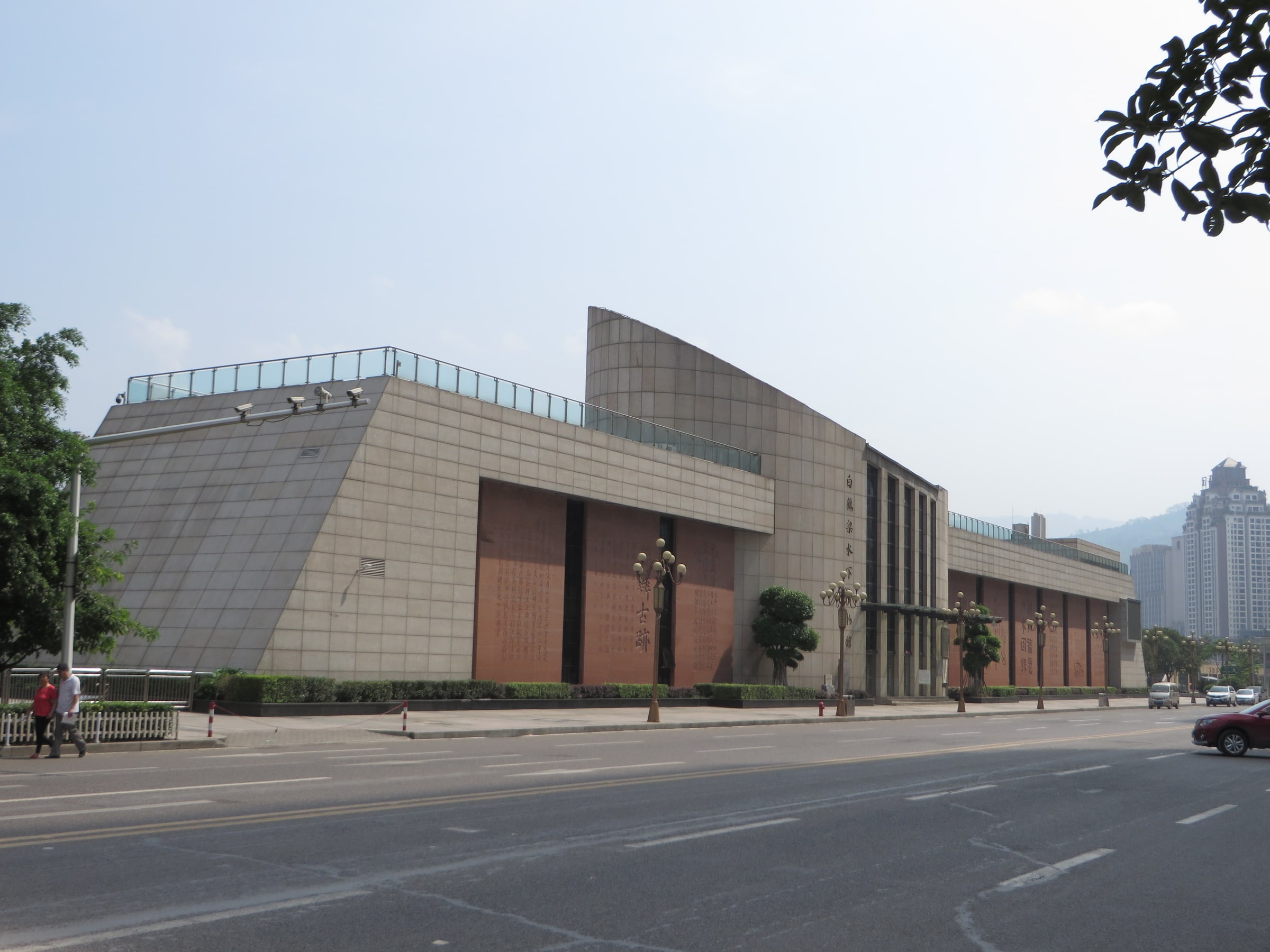
Baiheliang Underwater Museum in Fuling offers a focused 2026 outing for travelers interested in the Yangtze, archaeology and engineering. UNESCO's Tentative List describes records spanning roughly 1,200 years. The attraction is seeing how carved fish and inscriptions tracked low water, with the underwater section's availability checked before making the journey.
Cover: Baiheliang Underwater Museum's street-facing exterior in September 2014. Historical identity view; current entrance arrangements and conditions require a separate check. Photograph by Jpbowen, 2014-09-14, CC-BY-SA-4.0. Resized and JPEG-compressed for the web; full composition retained.
The museum's name can create the wrong expectation. This is not an aquarium or a diving excursion. The central subject is a stone ridge and what people recorded on it over centuries. The museum's unusual setting is part of the story of protecting those records in place.
Choose the outing because that subject interests you. Fuling is a separate destination from the downtown Yuzhong sights, so the visit deserves its own transport plan. This guide explains what to look for and what the available sources actually establish, while keeping current operating questions separate from historical descriptions.
Start with the question the stone fish answered
The UNESCO Tentative List submission describes 72 recorded low-water years across roughly 1,200 years. The fish and inscriptions were connected to observing the river at low water. They were useful records as well as carved objects, which is the central idea to carry into the galleries.
Try approaching the displays with three questions. What acted as a reference point? What did observers record when the water receded? Why would people living and working beside a large river want those observations preserved? You do not need to read every inscription to understand the relationship between a fixed mark and a changing water level.
Keep observation and interpretation separate. Historical beliefs about harvests are part of the site's cultural history. They should not be turned into a modern promise that one visible fish predicts the following year's conditions. Look for the museum's explanation of what was measured and how researchers interpret the evidence.
For visitors who usually find inscriptions difficult to engage with, this practical purpose gives the writing a point of entry. The lettering records people responding to an environment that affected travel, work and everyday decisions.
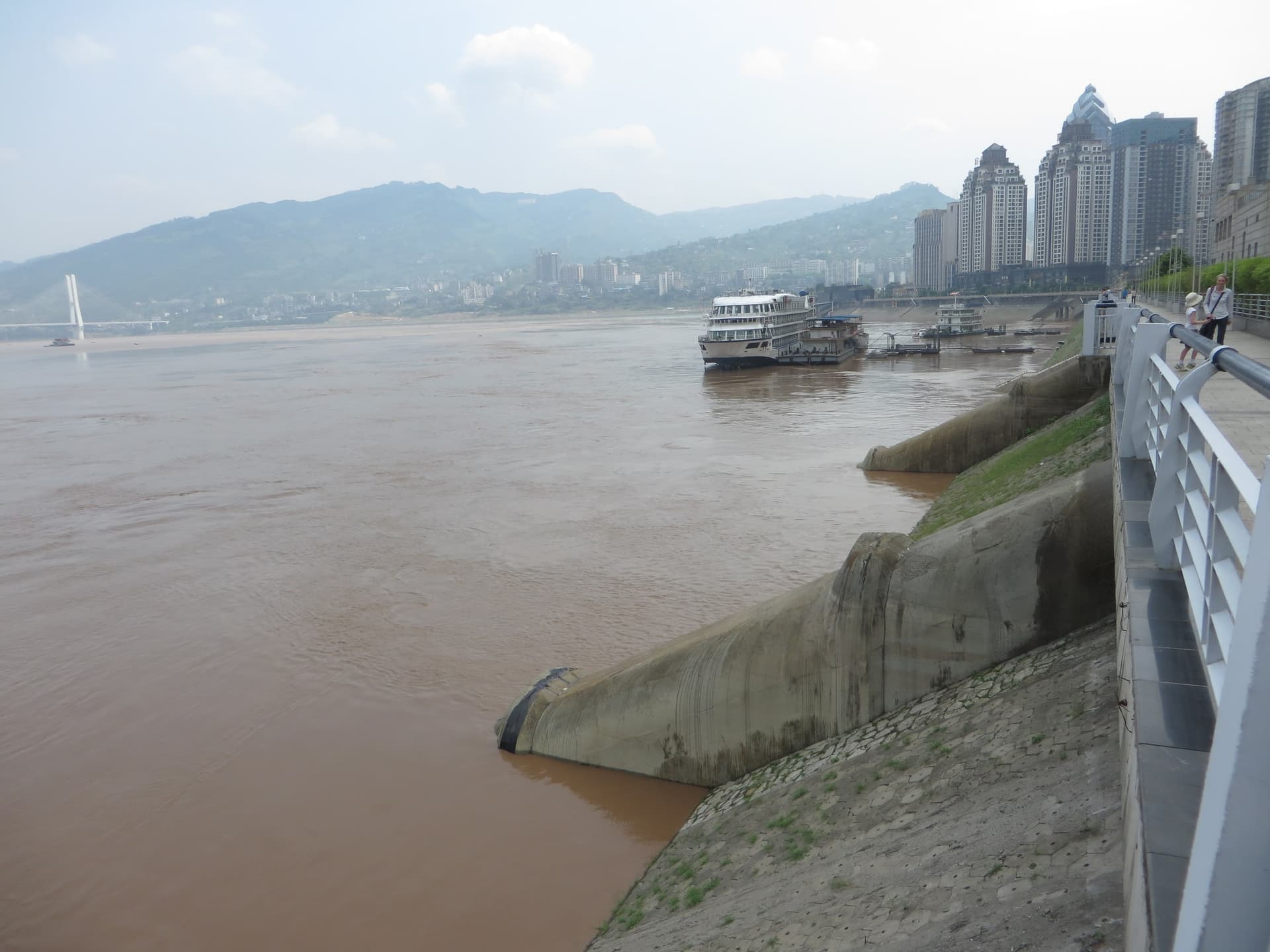
The museum's escalator-shaft structures beside the Yangtze, photographed from outside in September 2014. This is not an interior escalator view; the river level and riverside access shown are historical. Photograph by Jpbowen, 2014-09-14, CC-BY-SA-4.0. Resized and JPEG-compressed for the web; full composition retained.
Understand how visitors and the relics are separated
In its 13 May 2024 report, Xinhua describes visitors descending to a corridor and observing the stone carvings through windows. It also explains a protective container filled with filtered river water and a separate pressure-resistant visitor passage. The public experience does not require scuba equipment.
That distinction matters when looking at photographs. The water belongs around the preserved relics; the visitor route is a separate space. Images of divers performing conservation work do not describe an activity included in a visitor ticket. Likewise, a photograph of a model is not a photograph taken outside the underwater windows.
Treat this explanation as a description of the museum concept. It does not establish whether the underwater section is operating throughout your chosen day, how long a group may remain there, or what viewing conditions will be like. Those questions belong in the operator check before travel.
If anyone in your party is uncomfortable with a long descent or enclosed passage, describe the actual arrangement before buying transport. Ask the museum about the current route and alternatives. Do not promise that a surface-only visit has the same price or experience without confirmation.
Read the admission notice carefully
The operator's visitor-guide page, rechecked on 2 October 2026 UTC, links an admission notice dated 30 September 2025. That notice says advance reservations were removed from 1 October 2025 for the named institutions, including Baiheliang. It also says Baiheliang remains a paid-entry museum.
Those are two separate facts: no advance reservation under that notice does not mean free entry, immediate entry or unlimited capacity. The same announcement asks visitors to follow crowd alerts and on-site instructions. Read both parts rather than taking “no reservation” as a promise that you can arrive at any time.
The notice refers to valid identity documents but does not spell out the complete foreign-passport purchase workflow. Before a dedicated trip, confirm which document to bring, whether you can buy directly at the museum and how any online ticket option handles your document. Carry the original document the operator tells you to use.
This research did not establish a current official ticket price or a 2026 National Day timetable. Do not substitute a price-regulator notice from many years ago or an undated booking-site panel. Check the operator's current announcement and ticket screen for the exact visit date.
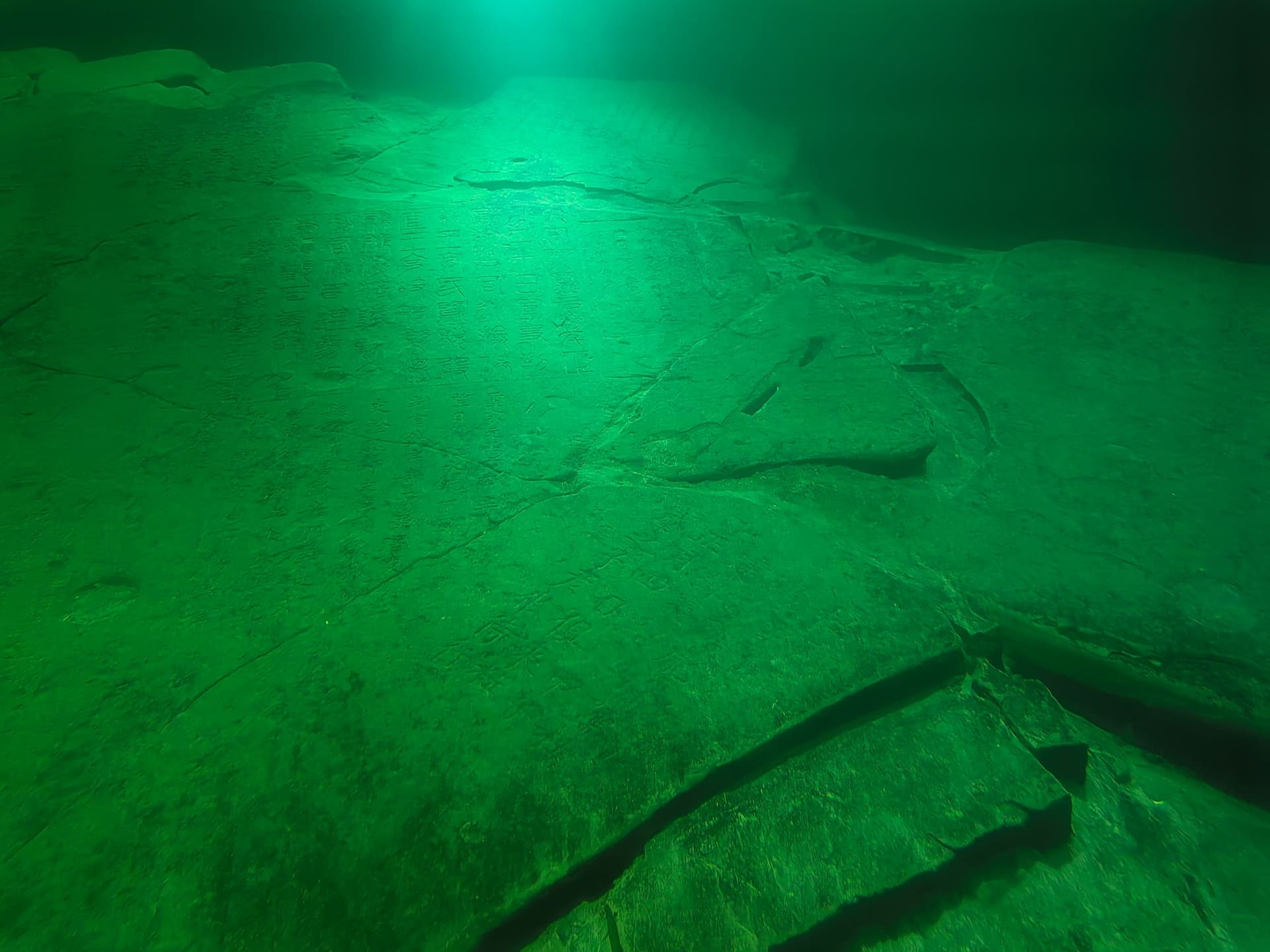
A green-lit Baiheliang inscription that the source identifies as the inscription by Xu Zhuang and others, photographed in May 2025. It is a rock-detail photograph, not a corridor view or a promise of today's underwater visibility. Photograph by Yumeto, 2025-05-22, CC-BY-SA-4.0. Resized and JPEG-compressed for the web; full composition retained.
Plan the Fuling journey as a complete return trip
Set aside one dedicated outing rather than inserting the museum between two downtown appointments. The UNESCO site description identifies Baiheliang with Fuling; the destination name in your navigation should be 重庆白鹤梁水下博物馆, with 涪陵 included when needed to disambiguate it.
If you travel by railway, compare the actual trains offered for your date and inspect the final connection from the arrival station to the museum. Station names that share “Fuling” are not interchangeable meeting points. Check the arrival station, return station and local connection individually. Our railway-stations guide explains why those details matter.
Work backward from the return train or other fixed commitment. Include the trip back to the station, entry procedures and a margin for disruption. Then decide how much museum time is available. A short train journey on a listing does not equal a short door-to-door outing.
For a car journey, obtain a live route estimate from your actual starting point. Agree on the pickup place and return arrangement before leaving. The decision should compare the complete journey and its cost, rather than an attractive one-way estimate.
Give the surface displays a job to do
Use the surface part of the visit to prepare for the underwater part. Select two subjects: how the river observations worked, and how the site was protected. The museum's 2026 water-culture outreach report describes staff explaining stone-fish water gauges, Yangtze hydrological history and water protection. Those are useful interpretive themes to look for.
Read enough context to recognize what you are seeing later. If you rush directly toward the unusual descent, the inscriptions may become an image without an explanation. A few well-chosen labels can make the viewing portion more meaningful than trying to photograph every display.
For families or mixed-interest groups, give each person a manageable question. One person might follow the stone fish, another the engineering, another the shapes of the writing. Share one thing you understood afterward. This is a suggested way to use the museum, not a claim that a specific children's program is available.
Ask about interpretation in the language you need. This research has not verified an English guided tour, audio-guide inventory, guaranteed bilingual labels or a fixed free-tour schedule. Translation tools may help with permitted labels, but they should not replace the operator's safety instructions.

A physical museum model photographed in May 2025, showing the surface building and the connecting underwater structures. This is a photograph of a model, not a view of the actual underwater exterior or a measured route diagram. Photograph by Yumeto, 2025-05-22, CC-BY-SA-4.0. Resized and JPEG-compressed for the web; full composition retained.
Check accessibility and photography before descending
There are two useful moments to ask questions: before buying the journey, and again before joining the underwater route. The documented visitor arrangement includes a descent and enclosed passage, so a broad statement that the building has an entrance does not answer route-specific mobility needs.
Ask about step-free access, the current lift or escalator arrangement, places to rest and whether a companion can remain above ground. Name the equipment you use if that affects access. No continuous wheelchair route or alternative return route has been verified for this guide.
For photography, follow the museum's current instructions at each section. Do not assume that permission in the surface galleries applies to every part of the underwater visit. Avoid blocking observation windows while reviewing pictures, and leave space for other people to look.
Use photographs as a record of the object, not a substitute for understanding it. Before moving on, identify one visible feature and connect it to the explanation you read above ground. If visibility or group movement limits photography, the interpretation can still be worthwhile without a particular shot.
Keep the heritage status accurate
Baiheliang appears on China's UNESCO Tentative List, submitted in 2008. That is different from inscription on the World Heritage List. The official UNESCO record should control the wording rather than a promotional description that blurs those stages.
iChongqing reported in March 2026 on a joint nomination project involving Baiheliang and Egypt's Nilometer. A nomination project is still not proof of completed inscription. You can appreciate the site's interest without giving it a designation that the cited record does not establish.
This is also a useful way to think about the museum itself: distinguish the original ridge, the historic marks, the conservation structure and the modern interpretation. They work together, but they are not the same object or the same age.

Baiheliang rock inscriptions in May 2025, including the large 白鶴梁 (White Crane Ridge) lettering. The source annotations identify inscriptions by Sun Hai and Huang Tingjian. This dated image does not establish present viewing conditions. Photograph by Yumeto, 2025-05-22, CC-BY-SA-4.0. Resized and JPEG-compressed for the web; full composition retained.
About This Guide
Sources were opened on 1 October 2026, including the museum operator, UNESCO, Xinhua and iChongqing. The operator's admission notice and UNESCO Tentative List record were rechecked on 2 October 2026 UTC (3 October in Chongqing). This AI-prepared guide claims no human review or on-site visit. Admission wording preserves the 2025 notice's date. Current hours, prices, underwater access and foreign-document procedures need direct confirmation. For a downtown alternative, see our Three Gorges Museum guide.
Frequently Asked Questions
Q: Do I need to dive to visit Baiheliang? A: No. The documented visitor experience uses an enclosed corridor with observation windows. Confirm that the underwater section is available on your chosen date.
Q: Do I need a reservation? A: The operator's currently linked notice, dated 30 September 2025, removes advance reservations from 1 October 2025, including Baiheliang. It also retains crowd controls, so check for date-specific updates before traveling.
Q: Is Baiheliang Underwater Museum free? A: The same operator notice says Baiheliang requires a paid ticket. This guide has not verified a current 2026 official price or discount eligibility.
Q: Is Baiheliang a UNESCO World Heritage Site? A: The UNESCO source checked for this guide lists it on China's Tentative List, submitted in 2008. A tentative listing or joint nomination project is not completed World Heritage inscription.
Q: Can I combine it with the Three Gorges Museum in downtown Chongqing? A: They are separate visits in Fuling and Yuzhong. Plan the complete journeys and opening arrangements rather than assuming they form one short museum circuit.
Traveler comments
Share a recent experience or ask a practical question about this guide.