
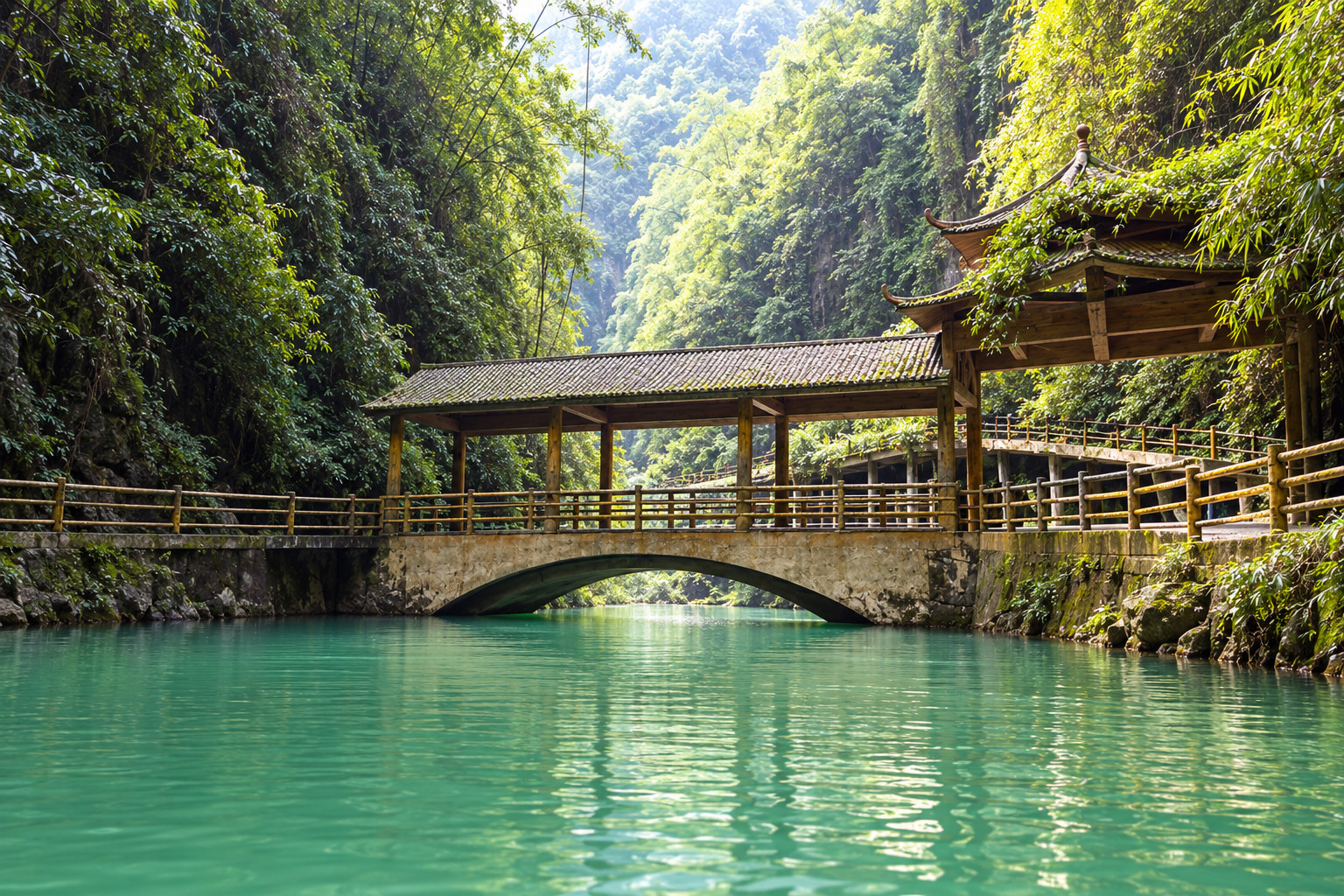
Cover illustration: AI-generated Ayi River scene informed by a historical photograph of a roofed entry bridge and gorge. Architecture and viewpoint are approximate; this is not a current photograph or proof of public access.
AI illustration created with OpenAI image generation. Reference: iChongqing’s Ayi River report, published 3 November 2020; individual photographer and capture date unknown. Reference photograph is not republished.
All scene images here are AI-generated illustrations informed by historical Ayi River photographs. Viewpoints, architectural details and natural features are approximate. They do not verify current routes, water conditions, craft types, facilities or activity operation. No bamboo raft or rafting equipment is depicted.
Ayi River in 2026 needs an activity decision before a ticket decision. Chongqing's municipal tourism description separates three sightseeing areas, including walking and bamboo-raft experiences, from rafting activities. Choose the kind of day your group wants, then confirm that specific product's operation, requirements and exit transfer before travelling to Pengshui.
The destination name is 阿依河景区, Ayi River Scenic Area, in Pengshui Miao and Tujia Autonomous County. A listing for the scenic area is not automatically a booking for a rafting section. Nor does “boat tour” tell you whether you will be sitting on a managed sightseeing craft or helping propel a raft.
This desk-researched guide does not certify present river conditions. Current activity operation, eligibility, equipment and routes must come from the operator for the date you choose. Treat “open” on a general travel-platform page as the start of that check, not its conclusion.
Match the experience to the whole group
The municipal introduction of 11 June 2026 distinguishes gorge sightseeing, walking and bamboo rafting, alongside other activity zones. That makes it possible to think about Ayi River without assuming that everyone has come for the same water experience.
Begin with three preferences: how much walking people want, whether they want to get wet and how comfortable they are committing to a river activity they cannot simply leave halfway through. Ask each person directly. A confident member of the group should not answer for everyone else.
For a landscape-focused visit, investigate the permitted walking sections and any suitable sightseeing product. For an active day, investigate the named rafting product and its demands. A mixed group might split temporarily, but only after confirming separate routes, supervision needs and a reliable meeting arrangement.
Avoid “gentle” or “adventurous” as your whole product description. Ask what the activity involves: craft type, whether visitors paddle, boarding and exit arrangements, time commitment, and the operator's participation rules. Two products sold under one attraction name can ask very different things of a visitor.

AI-generated riverside illustration based on a historical photograph titled Ayi River. The exact sector is unverified; path details and viewpoint are approximate. It does not establish current access, route continuity or step-free conditions.
AI illustration created with OpenAI image generation. Reference: hanaposy’s Ayi River photograph, provider-dated 15 July 2012, time zone unverified. All-rights-reserved original used internally as reference only and not republished.
Unpack the ticket into its separate parts
The tourism group's attraction page lists a range of experiences and links to an Ayi River route and ticket service. It does not establish that a basic admission purchase includes every activity, transport leg or facility mentioned in the description.
Write down the product in plain terms before comparing sellers. Does it include admission, a particular walking route, an elevator or internal vehicle, bamboo rafting, a rafting segment, and transport from the finishing point? Keep those as separate questions until the seller explains the actual bundle.
Check two kinds of deadline: the time to exchange or validate the ticket and the cutoff for starting the selected activity. A park may admit visitors after the last practical start for a longer river experience. Arriving before the general closing time does not resolve that distinction.
If a promotion is cheaper than another listing, compare the route and inclusions before deciding it is the same thing. Read the cancellation terms for the exact seller and product, including what happens when one component cannot operate. Do not assume a weather cancellation makes every associated expense refundable.
This research did not verify a current operator-issued tariff or complete eligibility rules. Rather than publish a misleading low headline price, the guide leaves those numbers for the date-specific product check.
Do not treat bamboo rafting and rafting as interchangeable
The official tourism-group description places bamboo rafting and rafting experiences in different categories. Keep the Chinese product name when speaking to a seller. Translating both simply as “rafting” can hide a meaningful difference in what you are buying.
The public Ctrip rafting page separately refers to full-route and lower-section products. Those labels are useful questions to put to the operator, but the page is not enough to establish which sections are operating, their current character or who is eligible to use them.
A review dated 15 July 2026 reports considerable active paddling and getting wet. This is one visitor's experience, not a measured proportion of every trip. Still, it is a reason to ask whether your group expects to paddle and whether the seller's description matches that expectation.
Do not infer difficulty from the words “upper” and “lower,” or from a dramatic video of one rapid. Water conditions, route management and the craft can affect the experience. Likewise, a calm-looking photograph cannot establish that a product is appropriate for children, non-swimmers or a particular person's circumstances.

AI-generated landscape illustration based on a historical Ayi River-labelled photograph. Rock detail and viewpoint are approximate; the exact sector is unverified. This shows landscape context, not a bamboo-raft product, water-safety assessment or current activity conditions.
AI illustration created with OpenAI image generation. Reference: hanaposy’s wooded-cliff photograph, provider-dated 15 July 2012, time zone unverified. All-rights-reserved original is reference-only and not republished.
Check participation rules before the day of travel
Use the operator's requirements for the named activity, not the scenic area's general discount policy. A child might qualify for discounted entry while being ineligible for a water activity. A concession and permission to participate are separate decisions.
Ask about age and height restrictions, required supervision, swimming-related requirements, health exclusions and how the safety briefing is delivered. This guide gives no universal cutoff because a current operator rule set was not verified. If a requirement or warning is unclear, resolve it before buying or entering the activity.
For two people sharing a craft, clarify who controls it and what participation is expected from each person. Do not make assumptions based on gender or take a reviewer's fitness judgment as a rule. Describe your actual concern to the operator in ordinary terms.
At the activity, use the equipment and follow the briefing provided by authorized staff. Do not remove safety equipment for photographs, enter a closed section or substitute an unofficial river access for a cancelled product. A ticket is not permission to ignore instructions at the water.
If participation is uncertain, choose another activity rather than improvising a compromise on the riverbank. The useful planning decision happens before everyone has travelled, changed clothes and become reluctant to disappoint the rest of the group.
Plan for wet belongings and the finishing point
For a water-based visit, separate what must stay dry from what you need during the activity. Keep essential documents, spare clothing and electronics out of the exposure path where a verified storage or transport service allows it. Confirm the service first; this guide does not establish that lockers or luggage forwarding are available for every product.
Ask where you change before starting, where your belongings will be when you finish and whether the finishing area has the facilities you need. A photograph of a changing room from an older visit is not confirmation that it is open, included or at your exit.
Choose footwear and clothing that meet the operator's instructions. Avoid loose items that might be lost or interfere with equipment. A waterproof phone pouch is not a reason to hold a phone when you need both hands for the activity.
Leave space in the day for two practical transitions: preparing to start and getting ready to leave. Neither is captured by the advertised activity duration. Food, toilet access and the return vehicle should fit around those transitions rather than rely on a hurried departure in wet clothes.
For a walking visit, carry a manageable amount of water and protect belongings from rain. Our heat and stairs guide provides general planning questions, while the actual Ayi route and facilities still require their own check.

AI-generated elevator-and-gorge illustration informed by a historical Ayi River photograph. Equipment details and viewpoint are approximate. This does not identify an activity exit or verify operation, ticket inclusion, storage or a step-free route.
AI illustration created with OpenAI image generation. Reference: iChongqing’s Ayi River elevator image, published 3 November 2020; capture date and individual photographer unknown. The source photograph is not republished.
Treat a weather change as a new decision
Make one operation check before leaving your base, and check again on arrival if conditions or notices have changed. Ask about the specific activity, not just whether the scenic area is open. A closed rafting product and an open visitor centre can both be true.
Do not convert an old temporary closure into a claim that Ayi River is closed now. Equally, an old reopening notice does not guarantee operation on your date. Use a dated operator notice or a direct confirmation for the product you intend to take.
If rafting cannot proceed, a walking route is not an automatic safe substitute. The same weather may affect paths, gorges and transfers. Ask which areas, if any, are currently permitted; follow local restrictions rather than trying to recover the value of the ticket by finding another way to the water.
For a group visiting Pengshui mainly for the landscape, agree on a non-river alternative before setting out. That might mean a low-commitment local day after checking conditions, or returning without adding another attraction. A fallback is useful when it reduces exposure and uncertainty, not when it simply moves the group to another unverified gorge.
Connect the activity exit to the regional journey
A complete transport plan has at least three named points: your arrival terminal or base, the required attraction entrance, and the place where your selected route finishes. Check these against the actual product. The tourism-group website's Jiangbei office address is not the Ayi River attraction entrance.
For rail travel, verify the departure, arrival station and local connection for the travel date. Our railway-stations guide helps with those naming checks. No current Pengshui shuttle timetable or fixed rail-to-attraction time was verified for this article.
For a car arrangement, ask whether it covers a pickup from the activity's finishing area and whether waiting or a change of pickup point alters the price. Save the destination in Chinese and keep a working contact method. The taxi and ride-hailing guide explains general booking friction, but does not guarantee a car at a particular river exit.
Consider an overnight stay if it takes pressure off a confirmed longer activity and onward connection. Do not assume lodging inside the scenic area is available because a destination description mentions resort areas. Check the actual property, vehicle access and next day's departure arrangements.

Editorial product-scope diagram: separate sightseeing and rafting choices, then confirm admission, any elevator or vehicle, the activity finish and the exit transfer. This is not a mapped river route, safety assessment or current ticket bundle.
Original diagram by Chongqing Travel Editorial, based only on this guide’s planning questions. English portrait edition with selectable text.
Diagram text (selectable)
AYI RIVER / PENGSHUI
Separate the activity from the ticket
One scenic-area name can cover different products and commitments
SIGHTSEEING OPTIONS
- Entry and permitted walking sections
- Bamboo sightseeing product, if offered
- Ask: craft, effort, boarding and finish
- Check each component and inclusion
NAMED RAFTING PRODUCT
- Keep the exact Chinese product name
- Confirm the particular rafting segment
- Ask about participation and equipment
- Check current operation and cutoffs
CHECK BEFORE COMMITTING
Entrance + required activity + any elevator or vehicle + finishing point + exit transfer
Confirm each part with the operator. General admission does not establish inclusion.
Editorial product-scope diagram from this guide. Not a river map, safety assessment or current ticket bundle.
About This Guide
Research on 1 October 2026 used the June municipal introduction, the tourism group's attraction page and public Trip.com and Ctrip material. A July 2026 rafting review informed questions about active effort; its timings and subjective safety judgments were not generalized. Current primary operational rules remain unverified. This guide is not a safety assessment, a route survey or a report of firsthand participation.
Frequently Asked Questions
Q: Can I visit Ayi River without rafting? A: Official descriptions identify walking and other sightseeing areas as well as rafting. Confirm the permitted route and its ticket and transport requirements for your date; a water-activity closure does not automatically mean paths are open.
Q: Is bamboo rafting the same as the rafting product? A: The tourism-group description separates them. Keep the exact Chinese product name and ask about craft type, paddling, route and participation rules before choosing.
Q: Does entry include the elevator, raft and return vehicle? A: Do not assume so. Ask the seller to itemize the Ayi River product and identify the finishing point and included transfer.
Q: Is Ayi River rafting suitable for children? A: That depends on the current operator rules for the selected activity and the child. A scenic-area entry concession does not establish rafting eligibility; verify restrictions and supervision requirements directly.
Q: Can I book an onward train immediately after rafting? A: Leave margin for completion, changing, collecting belongings and the local transfer. Ayi River's advertised activity duration is not a verified door-to-station journey time.

Traveler comments
Share a recent experience or ask a practical question about this guide.