
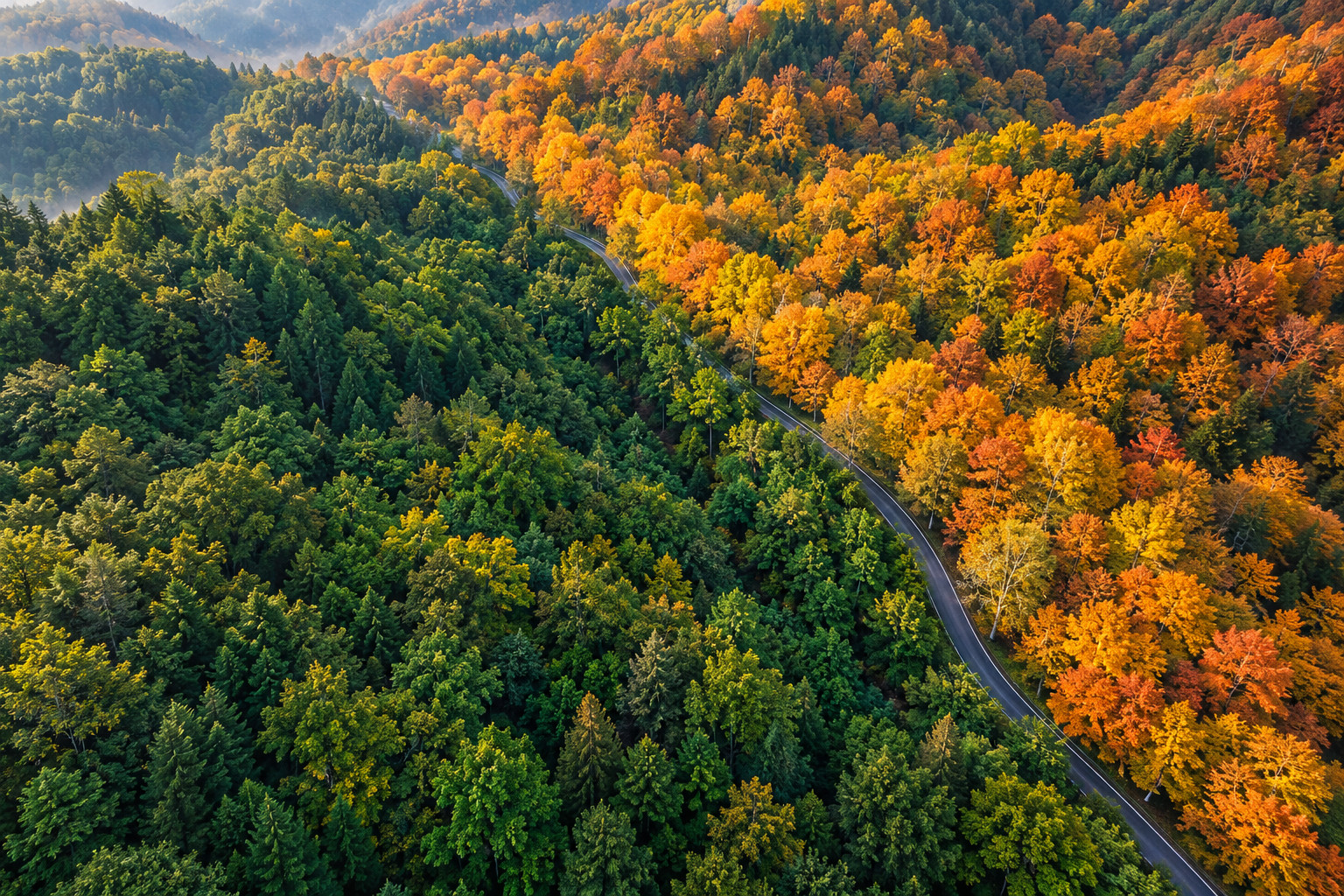
Cover illustration: AI illustration based on a historical photograph. Historical autumn canopy at Shanwangping with contrasting green and gold trees beside a road. Scene, terrain and architectural details are approximate; not a current photograph, access confirmation or navigation guide.
Historical reference only; original photograph not republished or licensed for reuse: Chongqing Municipal Forestry Bureau / Photographer not credited
This guide contains four explicitly labeled AI scene illustrations from historical photo references and one original localized planning diagram. Photograph capture dates and current access are not established by the page update dates. No independent review is claimed.
Shanwangping in Nanchuan is a forest-and-karst outing for 2026, not a promise of a perfectly divided autumn photograph. Chongqing’s forestry reporting dates the ecological park’s approval to October 2014 and explains its planted landscape. Choose it for forest walking, then check current colour, open paths and transport before committing to a specific view.
The name to save is 山王坪喀斯特国家生态公园. Shanwangping can also mean the surrounding town or a wider tourism area. A hotel advertising the name may not be at the park entrance, and a night-time entertainment product may involve a different visitor space from the forest you intended to see.
Decide what would make the trip worthwhile even if the trees are greener, browner or less evenly coloured than expected. If the answer is a quiet walk among trees and limestone, you have flexibility. If a particular aerial image is the entire reason for travelling, the current scene and permitted viewpoint need much more careful checking.
Understand the forest behind the famous picture
A Chongqing government report published in June 2024 describes Shanwangping’s restoration from exposed karst terrain. Planting began in the 1980s, including metasequoia and cryptomeria. A later phase, following the park’s approval in 2014, aimed to diversify the forest rather than maintain a uniform plantation.
This history changes how to read the view. The ordered stands are part of a worked and restored landscape. They need not be described as untouched wilderness to be interesting. At ground level, look at the relationship between tree roots, patches of soil and exposed rock, staying on the permitted path. The way vegetation occupies difficult terrain can be as engaging as the colour contrast seen from above.
The widely circulated split-colour scene depends on different trees, their seasonal condition and the viewpoint. A road-level photograph cannot necessarily reproduce an aerial composition. Ask where an advertised picture was taken and whether that viewpoint is available to ordinary visitors. A drone image can be an excellent illustration of a landscape while still being a poor promise of what a walker will see.

AI illustration based on a historical photograph. Vegetated limestone outcrop in Shanwangping ecological forest park. Scene, terrain and architectural details are approximate; not a current photograph, access confirmation or navigation guide.
Historical reference only; original photograph not republished or licensed for reuse: Chongqing Municipal Forestry Bureau / Photographer not credited
Choose a season with an honest fallback
Xinhua documented snow at Shanwangping on 11 January 2025. That proves a particular snowy scene occurred, not that winter visits reliably deliver the same conditions. The same principle applies to autumn photographs: a dated image is evidence of that day, not a timetable for future colour.
Before an autumn visit, look for recent images of the actual park and ask when they were captured. The upload date can be later than the visit, and a promotional collection can mix seasons. A useful current photograph should identify the place and show enough surroundings to establish its viewpoint. An attractive close-up of orange leaves tells you little about the condition of the whole forest.
Keep a broader objective for the day. If the leaves have not changed much, a forest walk and the karst landscape may still suit you. If rain limits distant views, consider whether the remaining open paths are worthwhile and safe for your group. If the weather makes the approach unsuitable, change the date or choose a lower-commitment outing instead of insisting on the original photograph.
For winter, check the road and park notices before departure. Snow in an old news image does not establish safe driving conditions, an open trail or equipment rental. For warmer months, judge clothing from the local forecast and your planned activity rather than assuming that any mountain label means effortless comfort. Carry a layer you can remove as conditions change.
Ask which forest and stone-forest paths are open
The Ctrip public attraction listing read in October 2026 describes forest recreation, ecological stone forest, a lake-and-ridge area and camping. Treat this as an orientation to the types of landscape advertised. It is not a verified map of every path open for your visit.
At the entrance, ask staff to identify a walk that matches your stamina and interests. Explain whether you want primarily forest scenery, rock formations or an accessible short outing. Ask where the route ends, whether it returns to the same entrance and what transport is available if you decide not to walk back. Take a photograph of the current visitor map where allowed, including any closure notices beside it.
A public review dated August 2025 on that listing raised concerns about shuttle costs and maintenance. That is one visitor’s account, not a finding that the same conditions persist. It does identify useful questions: which paths are maintained, which landmarks are reachable and whether a shuttle fare is separate from admission. Ask for the present answer rather than importing an old review’s prices into your budget.
Keep the distinction between a sightseeing path and a forest track. An unmarked branch, maintenance road or gap between trees is not an invitation to improvise a route. In the stone-forest area, stay within the visitor circulation and resist climbing formations for a clearer photo. If the current route does not match your group’s needs, a shorter forest visit is a reasonable outcome.

AI illustration based on a historical photograph. Close oblique detail of the viewing walkway's glass railing and wooden deck beside autumn woodland at Shanwangping, based on a photograph captured on 2023-11-07. Scene, terrain and architectural details are approximate; not a current photograph, access confirmation or navigation guide.
Historical reference only; original photograph not republished or licensed for reuse: Chongqing Municipal Forestry Bureau / Tang Yi / Xinhua
Separate the park from the wider driving route
Xinhua’s November 2023 report places Shanwangping on a 178-kilometre rural touring route around Jinfo Mountain. That number describes the wider driving itinerary. It does not mean that the forest park has a walk of that length, nor that Jinfo Mountain and Shanwangping share a ticket or visitor entrance.
Pick the park as the destination first, then decide whether a wider circuit helps your trip. Linking several named stops can look efficient on a map while reducing the time available for the forest itself. Confirm parking and the final entrance before setting off; a pin for Shanwangping town is too broad for an agreed pickup.
For a driver or transfer provider, write the full Chinese park name and the return destination. Agree on the waiting arrangement, meeting place and how to communicate if the route changes. If you are travelling without a vehicle, verify a dated outward and return service rather than assuming the regional touring route implies a regular public shuttle.
Avoid building the return around an uncertain late pickup. Forest walking is easier to enjoy when you know how the day ends. Our taxi and ride-hailing guide helps with communication and booking concepts, but it does not establish live car availability at this rural park.

AI illustration based on a historical photograph. Close view of snow-covered conifer branches at Shanwangping, approximately reconstructed from a historical reference; no current snow or road access is established. Scene, terrain and architectural details are approximate; not a current photograph, access confirmation or navigation guide.
Historical reference only; original photograph not republished or licensed for reuse: Chongqing Municipal Forestry Bureau / Photographer not credited
Treat the new night attraction as a separate choice
An iChongqing opening report dated 30 June 2026 describes Flowers and Full Moon opening in the Shanwangping area the previous day. The report discusses themed streets, performances and night-time entertainment. That gives the wider area another kind of visit, but it does not establish that the forest paths remain open after dark.
If you want to combine the forest and the night attraction, confirm their separate names, entrances, admission arrangements and transport. Ask where you will eat, where the driver meets you and whether staying nearby genuinely simplifies the return. Do not infer that free or extended access advertised for one product applies to the other.
The report is an account of an opening, not a current performance calendar. Its show descriptions and rotation claims should not be treated as guarantees for an ordinary evening months later. A specific performance may be the reason you choose to stay; if so, check that item directly and understand the conditions for cancellation or alteration.
Travellers looking for a daylight nature outing can keep the plan simple and return afterward. Others may prefer to split the experiences across an overnight stay. Neither arrangement requires turning the forest visit into a race to reach an evening show. For accommodation, compare the actual property location with both intended entrances instead of booking from “Shanwangping area” alone.
Plan comfort and photographs at ground level
The 2024 restoration account shows why this landscape deserves care: woodland here reflects sustained restoration work on difficult ground. Keep to marked routes, leave plants in place and carry your litter out. A short detour to photograph a tree should not become trampling around its roots or climbing over protective boundaries.
Bring footwear suitable for the confirmed path and forecast, with enough water for the outing you have agreed to undertake. This guide has not verified current refreshment points or every toilet location. Ask at the entrance where facilities lie along your selected route, especially before starting with children or a companion who needs frequent breaks.
For mobility planning, ask about gradients, steps and resting places on a specific path. Neither a forest-recreation label nor a broad road in a photograph proves that the full route is step-free. If you are comparing the trip with an urban day, our heat and stairs guide explains how to plan around effort without assuming every attraction has the same terrain.
Choose photographs available from a safe standing position. Use the rhythm of tree trunks, a curve in the permitted path or the meeting of rock and vegetation. Do not stand in a traffic lane to imitate a road-centre composition. If aerial photography is essential to your plans, obtain current local permission and rules through the appropriate operator; this guide does not establish permission to fly.
Keep the maps and navigation guide available for the journey, and save the park meeting point offline. A clear destination and modest walking plan will remain useful even when the light or leaves differ from the image that first caught your attention.

Original editorial planning diagram based on this article; not a photograph or geographic map. Planning checklist only; not a route map or current operating guarantee.
Original editorial planning diagram based on this article; not a photograph or geographic map.
Plan a Shanwangping visit
Choose your scope:
- Check the seasonal view you want to see.
- Confirm which park areas are open.
- Keep a poor-weather alternative.
Confirm before leaving:
- Recheck weather and current access.
- Arrange pickup and the return journey.
- Confirm fees and cancellation terms.
Planning checklist only; not a route map or current operating guarantee.
About This Guide
Prepared from sources read on 1 October 2026, including forestry reporting, dated Xinhua coverage, a public attraction listing and the June opening report for a separate entertainment development. No visit, timed walk or complete accessibility inspection is claimed. Current foliage, road conditions, park operations, camping permission and night-programme details require direct confirmation.
Frequently Asked Questions
Q: Will Shanwangping be half green and half orange when I visit? A: That composition depends on season, tree condition and viewpoint, and it cannot be promised for a specific visit. Check recently captured Shanwangping photographs and plan a forest outing that remains worthwhile without the exact split-colour view.
Q: Is Shanwangping the same attraction as Jinfo Mountain? A: Shanwangping ecological park and Jinfo Mountain are different visitor destinations in the Nanchuan area. Their connection within the 178-kilometre touring route does not establish shared admission or a single entrance.
Q: Are the forest trails open for the Flowers and Full Moon night programme? A: Forest-trail night access was not verified. The June 2026 report describes a themed entertainment development in the Shanwangping area, so confirm its entrance, hours and transport separately from the ecological park.
Q: Can I camp at Shanwangping without booking? A: A camping area at Shanwangping appears in the public attraction description, but current permission, availability, facilities and booking terms were not confirmed. Ask the operator before bringing camping equipment or assuming an overnight stay is allowed.
Q: Is Shanwangping suitable for someone who needs a step-free walk? A: A complete step-free route at Shanwangping was not established in this research. Ask the park to identify a current path with suitable gradients, surfaces, resting places and return options rather than relying on a general family-friendly description.

Traveler comments
Share a recent experience or ask a practical question about this guide.