
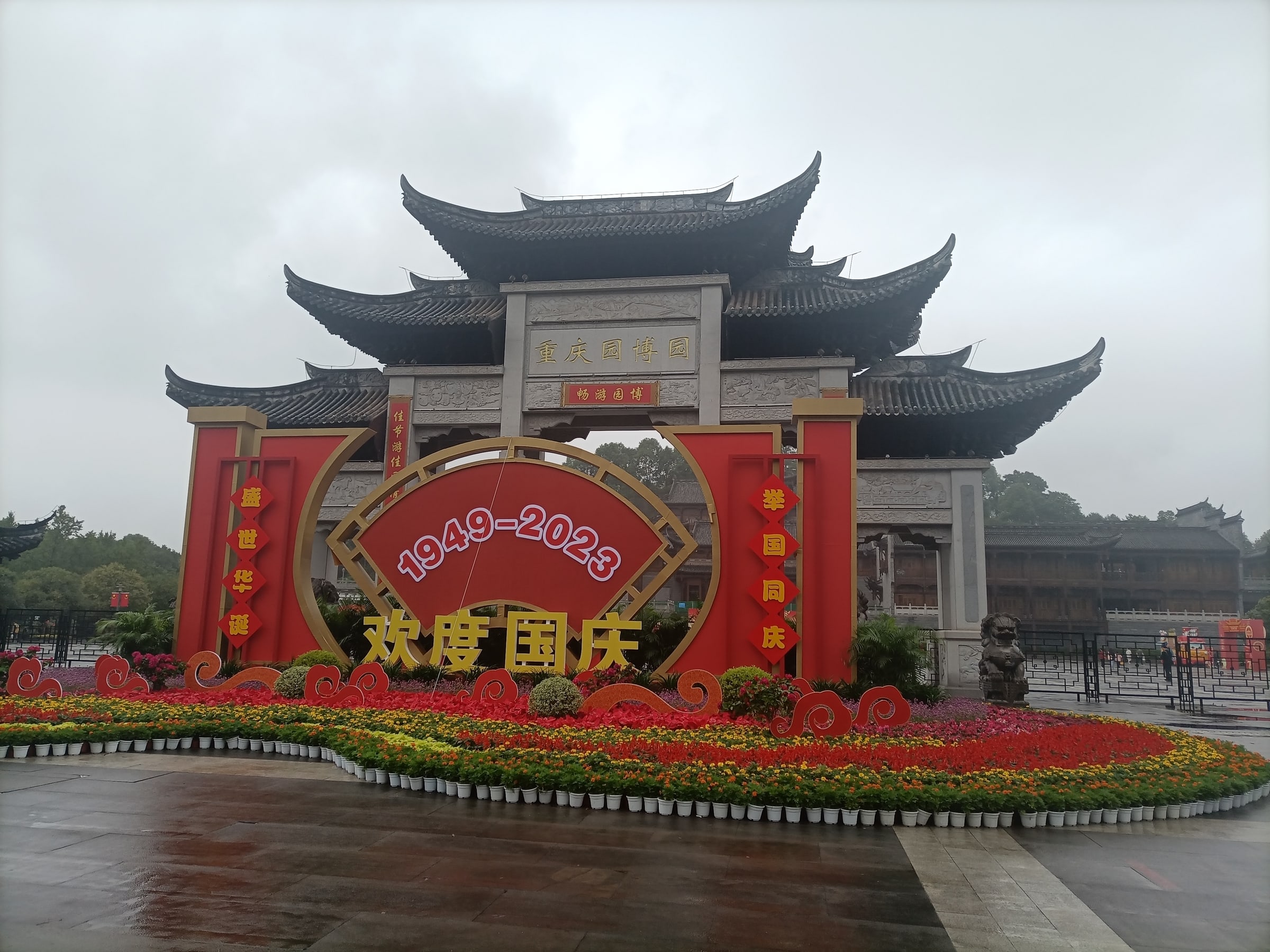
Chongqing Garden Expo Park in 2026 suits a selective garden-and-lake outing rather than a race around every display. The municipal parks authority lists 127 exhibition gardens. Plan around two interests, such as regional garden design and lakeside scenery, then choose a manageable section after checking the current entrance map.
Cover: Garden Expo Park entrance and its 2023 National Day display. This historical photograph does not show the current gate arrangement or current seasonal installation. Photograph by Xiumuzidiao, 2023-10-03, CC0-1.0. Resized and JPEG-compressed for the web; full composition retained.
The park is a deliberate change of subject from Chongqing's downtown skyline. Here the reason to go is garden composition: how buildings, water, planted areas and paths are arranged together. That is appealing if you enjoy looking closely. It may feel like too much travel and walking if your priority is fitting another landmark into an already crowded sightseeing day.
This is a source-based planning guide. Opening arrangements, seasonal installations and transport exits can change. The approach below helps you choose a visit without pretending that a photograph or an old festival notice proves what will be open when you arrive.
Understand the size before choosing a route
The municipal parks profile, dated 15 June 2026, describes a 12.8-kilometre lake ring road. Treat that figure as a warning against casually promising yourself a complete circuit. It is a description of the park's infrastructure, not a recommended walking distance for every visitor.
Start with one question: do you want a broad landscape walk or a closer look at individual gardens? A landscape-led visit can prioritize an accessible stretch beside the lake and one architectural subject. A design-led visit can concentrate on a small cluster of display gardens. Both can be satisfying without covering the whole park.
For a half-day allocation, include the outward journey, the return journey, a meal or rest and whatever waiting the entrance requires. The phrase “half-day” here is an editorial planning choice, not an official visit duration. If your accommodation is far away, the time left inside the park may be substantially smaller than the block on your calendar suggests.

The Houston display garden, photographed in 2023. The original place-name sign is part of the photograph; this view does not establish present access or maintenance conditions. Photograph by Xiumuzidiao, 2023-10-03, CC-BY-SA-4.0. Resized and JPEG-compressed for the web; full composition retained.
Keep the destination and the two station names separate
Save 重庆园博园 as the park's Chinese name. The municipal profile places it on Longjing Road in Yuanyang, in Liangjiang New Area. A historic iChongqing garden article gives No. 1 Longjing Road, but a street address still does not identify the entrance you need on a particular day.
There are two similar rail names to distinguish. The EXPO Garden, 园博园, is associated with Line 3. The EXPO Garden Center, 园博中心, is a different station associated with Line 5. The station reference explicitly separates them. Do not shorten both to “Expo station” when asking for directions or comparing navigation results.
Choose your park entrance first, then inspect the full connection from the station to that entrance. A pin in the middle of a large green area is useful for recognizing the destination but poor guidance for the final approach. Check the current station signs and park map rather than relying on an exit number copied from a festival article several years old.
If you use a car, send the driver the confirmed gate name in Chinese. Keep the return pickup point as a separate saved pin. A large park may offer more than one plausible meeting point, and “where you dropped us” becomes unhelpful if you leave through another entrance.
Choose garden subjects instead of a checklist
The 2026 park profile lists regional garden sections and named buildings including Bayu Garden, Longjing Academy and Chongyun Tower. Those names give you a way to choose a theme before setting out. They do not establish that every building interior can be entered.
Select two visual interests and give each enough attention. You might compare the way courtyards frame a view, then look at how a waterside structure relates to its surroundings. Another visitor may prefer planting and reflections. This is more useful than collecting a long list of names that all blur together afterward.
At the entrance, locate your selected subjects on the current map. If they are widely separated, replace one with a nearby alternative. The point is to make your interests fit the visit, rather than turning a nominally relaxed park outing into an endurance walk.
A practical exercise for companions is to choose one feature each: a roofline, an enclosed view, a bridge or a planting detail. Compare what attracted your attention when you stop. You do not need specialist terminology, and you do not need to claim that a display represents an entire region's garden tradition.

Longjing Academy's exterior entrance in March 2012. The historical photograph illustrates the architecture and does not establish current interior access. Photograph by Nyx Ning, 2012-03-23, CC-BY-SA-3.0. Resized and JPEG-compressed for the web; full composition retained.
Build a visit that can get shorter
Use three stages: orient, explore and return. These are planning stages, not a mapped official trail. During orientation, identify the current gate, toilets, rest options and a clear way back. During exploration, follow your chosen cluster. During the return stage, stop adding new targets simply because they appear close on the map.
Set a decision point before you start walking. For example, reassess after the first garden cluster: is everyone still interested and comfortable, and can you return without rushing? If the answer changes, shorten the plan. There is no need to complete a circuit to make the outing count.
The park's size, documented by the parks authority, makes return planning more important than a long list of attractions. If a map shows visitor transport, verify its actual boarding point, fare, service area and last departure before relying on it. This research did not establish a current sightseeing-bus or boat service, so none is promised here.
Allow someone in the group to opt out of an extra walk without losing the meeting plan. Agree on a visible public meeting point and keep enough phone battery for the return. That small amount of organization is often more useful than squeezing in another garden.
Separate seasonal appeal from current evidence
There are two different questions: does the park contain flowering plants, and will a particular display be in bloom on your date? A historic February 2019 iChongqing article describes blossom viewing. It does not answer the second question for October 2026 or for a future spring trip.
If flowers are the main reason for the journey, seek a current, dated park update showing the named area. Check when the image was taken, not merely when a travel account reposted it. A collection of attractive old photographs is inspiration, not a bloom forecast.
Apply the same discipline to lantern shows and evening access. A notice for a named event can have its own admission system, gate allocation and operating hours. Those details should not become the opening hours of the whole park after the event has ended.
This distinction also prevents unnecessary purchases. Before paying for a ticket or package, read the exact date, covered area and cancellation terms shown by the seller. A general park name on a listing is not enough to establish which experience is included.

A lake-and-garden panorama from March 2012. The boats, planting and water conditions belong to that capture date and do not establish current services or a bloom forecast. Photograph by Nyx Ning, 2012-03-23, CC-BY-SA-3.0. Resized and JPEG-compressed for the web; full composition retained.
Make comfort and access part of the plan
Ask two access questions before committing: can everyone reach the chosen entrance comfortably, and can everyone use the specific route you intend to follow? A description of a large public park does not prove a continuous step-free route through every display garden. This guide has not verified wheelchair routes, mobility rentals or lift availability.
If those details determine whether the visit is possible, ask the park directly about your intended gate and destination. A useful question names both ends of the route. “Is the park accessible?” is broad enough to produce an answer that misses the obstacle relevant to you.
Check the actual weather forecast and carry what your chosen outing requires. Our heat and stairs guide explains how to leave room for shade and rest in a Chongqing itinerary. For this park, a shorter route with a clear return is a sensible default when conditions make extended outdoor walking unappealing.
Food is another decision to make before you are tired. This research has not verified current vendors or their opening hours. Bring suitable drinking water and plan where you will eat before or after the outing, subject to current park entry rules. Do not assume that an old event's food stalls remain in place.
Decide what to pair with the outing
Choose one flexible activity afterward rather than a second tightly timed attraction. Your return journey, comfort and interest should decide how much remains in the day. A meal close to your accommodation can be a more useful pairing than crossing the city again for a photograph.
If this is a short first trip, compare the park with the central sights you would otherwise visit. The attraction serves a distinct interest in landscape and gardens; it does not have to replace a riverfront walk for every traveler. If you already have several garden visits elsewhere in China, decide what you want to learn here before spending the travel time.
For the practical setup, use our metro guide and navigation guide. Save the destination, chosen gate and return point before leaving. The municipal park profile remains useful background, while current operator notices should decide the day-specific details.

A side view of a covered bridge in Garden Expo Park in March 2012. This photograph does not establish whether the bridge or the photographed approach is currently open. Photograph by Nyx Ning, 2012-03-23, CC-BY-SA-3.0. Resized and JPEG-compressed for the web; full composition retained.
About This Guide
Prepared with AI from sources opened on 1 October 2026, including the municipal parks authority, iChongqing and station references. The municipal park profile was rechecked on 2 October 2026 UTC (3 October in Chongqing). No on-site visit or human review is claimed. Suggested visit pacing is editorial advice. Current prices, opening hours, gate availability, transport services and detailed accessibility remain direct-operator checks. Historical image dates must stay visible.
Frequently Asked Questions
Q: Is Chongqing Garden Expo Park suitable for a half-day visit? A: Yes, if you choose a limited section and include the return journey in that allocation. The authority lists 127 exhibition gardens, so a half-day plan should not aim to cover everything.
Q: Which metro station should I search for? A: Distinguish 园博园 on Line 3 from 园博中心 on Line 5. Choose the park entrance and check the current station-to-gate route before selecting either.
Q: Can I use an old lantern-show timetable for the park? A: No. A 2026 festival notice may describe a particular exhibition area and period; it is not evidence of the whole park's current opening hours.
Q: Will there be cherry blossoms during my visit? A: A historical photograph or February 2019 article cannot establish the flowering conditions on your date. Check a recent park update naming the display you want to see.
Q: Is the entire park step-free? A: This guide has not verified a continuous step-free route. Ask the park about the specific entrance and garden section you plan to use, including the return route.

Traveler comments
Share a recent experience or ask a practical question about this guide.