
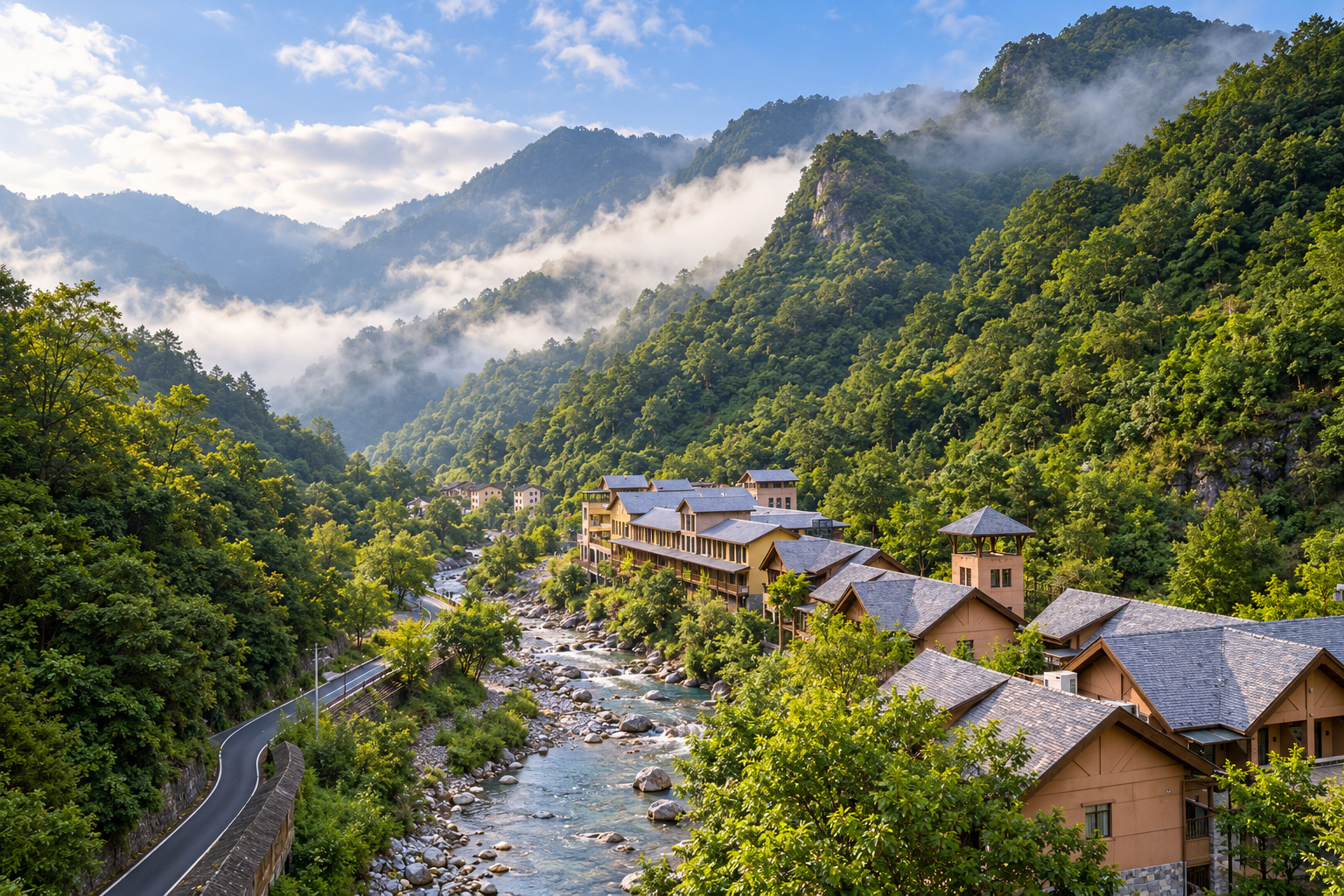
Cover illustration: AI illustration based on a historical photograph. Kanggu valley with documented buildings, stream and road between wooded slopes. Scene, terrain and architectural details are approximate; not a current photograph, access confirmation or navigation guide.
Historical reference only; original photograph not republished or licensed for reuse: Chengkou County Government / Photographer not credited
This guide contains four explicitly labeled AI scene illustrations from historical photo references and one original localized planning diagram. Photograph capture dates and current access are not established by the page update dates. No independent review is claimed.
For a Chengkou Daba Mountains stay in 2026, choose a confirmed village base before choosing walks. Chengkou’s April tourism profile places Kanggu in Xingtian village, Dong’an town, within a scenic area spanning 1,100–2,680 metres. That broad elevation range describes the destination, not an approved hiking route or the altitude of your room.
A village-based trip here is most appealing when staying, eating and taking modest local outings are the point. It is less forgiving if you want to arrive without a booking, improvise a mountain route and depend on a quick return to central Chongqing. Establish the practical arrangements first, then leave the relaxed part of the trip genuinely relaxed.
Save 城口县 for the county, 东安镇 for Dong’an town, 兴田村 for Xingtian village and 亢谷 for Kanggu. They identify different scales of place. A booking described simply as “Chengkou” does not tell you which valley, village or final approach you will use.
Choose the kind of base you actually need
The Chengkou government’s destination profile dated 21 April 2026 describes Kanggu as a municipal tourism resort and a 4A scenic area, with both hotels and 大巴山森林人家 accommodation. The latter is a regional rural-hosting label; it should prompt questions about the individual property rather than assumptions about a standard room or service package.
Xingtian and the Kanggu area are a logical starting point for someone who wants an established tourism setting in Dong’an. Ask where the property sits relative to the public visitor area and to the activities you actually want. A mountain view from the room is not evidence of a walkable connection to an attraction entrance. A listing can be geographically correct yet inconvenient for a traveller without a car.
A county-town base may make more sense when your priority is a simpler arrival, an onward journey or access to services you have confirmed there. A village base may suit a slower stay when meals, pickup and local outings are arranged. Neither is automatically preferable: the right choice depends on how much transport and communication you want to organise each day.
Before comparing décor, ask the host for the exact Chinese property name, map pin and vehicle access point. Make sure those details match the booking platform. If the advertised place is a cluster of buildings, confirm which one contains your room. A broad tourism-area name is insufficient for an unfamiliar driver arriving after a long journey.

AI illustration based on a historical photograph. Kanggu hillside accommodation exteriors; current amenities and booking availability are unverified. Scene, terrain and architectural details are approximate; not a current photograph, access confirmation or navigation guide.
Historical reference only; original photograph not republished or licensed for reuse: Chengkou County Government / Photographer not credited
Understand how village tourism developed
Municipal reporting in July 2026 traces Xingtian’s tourism development to 2011 and discusses accommodation clusters elsewhere in Chengkou, including Longpan and Liangshanmen. These are names to research as separate bases, not stops on a verified footpath or interchangeable descriptions of Kanggu.
An iChongqing field report from November 2020 describes residents developing guesthouse businesses in the Dong’an area. It helps explain why a forest stay can also be a stay within a working community. Its older travel forecasts and sweeping comfort claims should not be used as current booking facts.
Look for the relationship between hosting and ordinary village life. A courtyard may serve meals and still be someone’s family space. A lane may carry deliveries or farm traffic as well as visitors. Ask before entering a domestic courtyard or photographing people closely, and do not expect the village to arrange itself around a visitor’s preferred scene.
If local food is part of your interest, agree on the meal arrangement in advance. Ask what will be cooked, which ingredients matter to your diet and whether the price covers the whole table or each person. Avoid assuming that a rural accommodation label includes meals, that every ingredient is locally grown or that a host can adapt a complex request at short notice.
Build the transport plan from current information
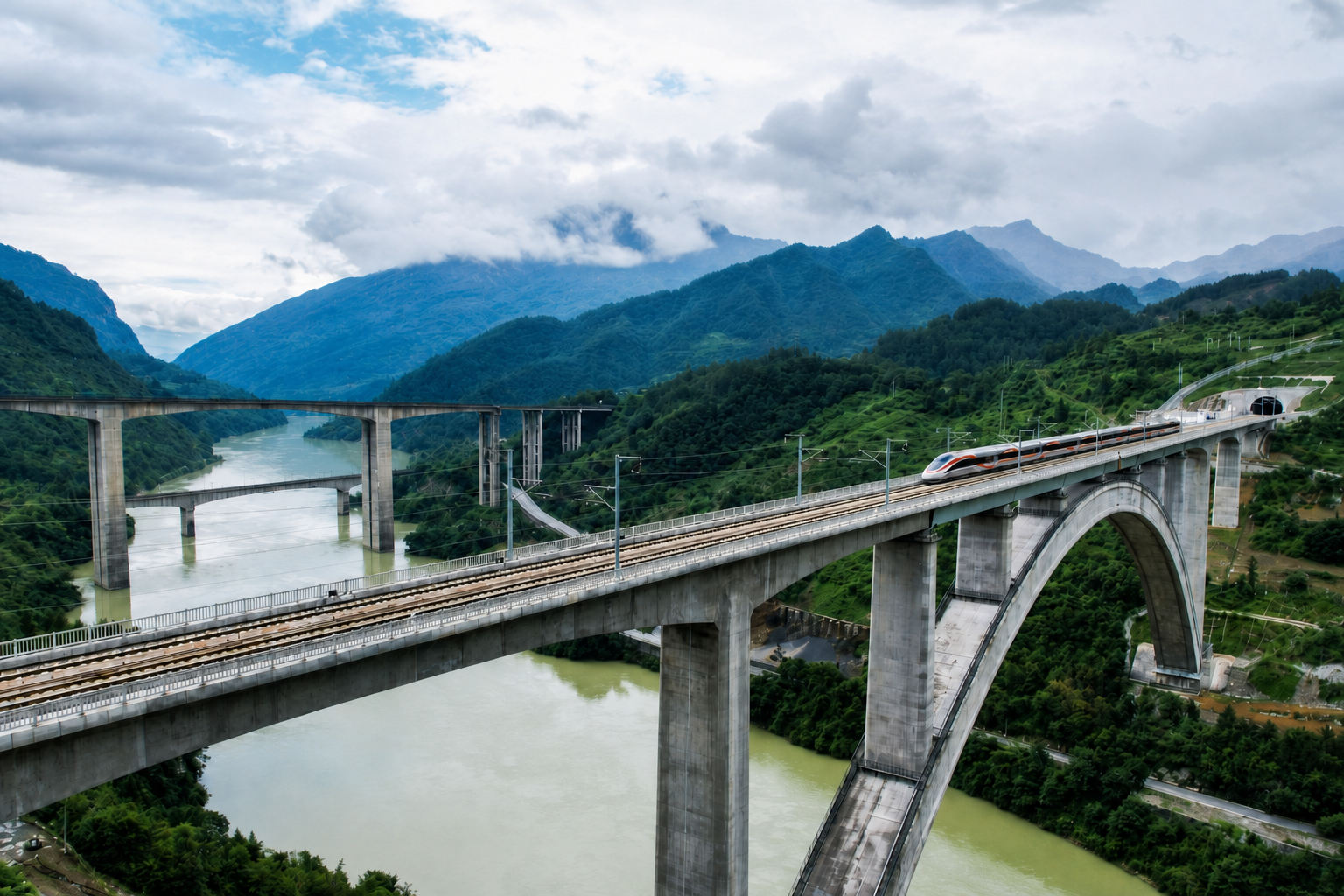
The July 2026 municipal report records the Chengkou–Kaizhou expressway opening in 2022 and describes the Chengkou section of the Xi’an–Chongqing high-speed railway as a future 2028 opening. Do not treat an older article’s optimistic rail forecast as evidence that a train to Chengkou is already running. Recheck the actual booking system for your travel date.
Separate the main journey to the county from the road journey to the property. Ask a host or transport provider to confirm where the handover occurs, who meets you and what happens if you arrive late. Keep the agreed meeting-point name in Chinese. “At the station” or “in the town” is not precise enough when several places could fit that description.
For a booked road transfer, confirm the destination, number of travellers, luggage space, return arrangement and any waiting charges before accepting the service. Ask the provider to assess the current road conditions. This guide does not establish a driving duration, public-bus timetable or the availability of a return ride on demand from a village.
Plan arrival in daylight where possible, particularly if the final approach is unfamiliar. That gives you time to find the right building and discuss the next day without rushing. Keep a simpler arrival-day plan: reaching the accommodation and settling in can be enough. The railway-station guide helps with verified station names elsewhere in the journey, while live rail availability needs its own check.
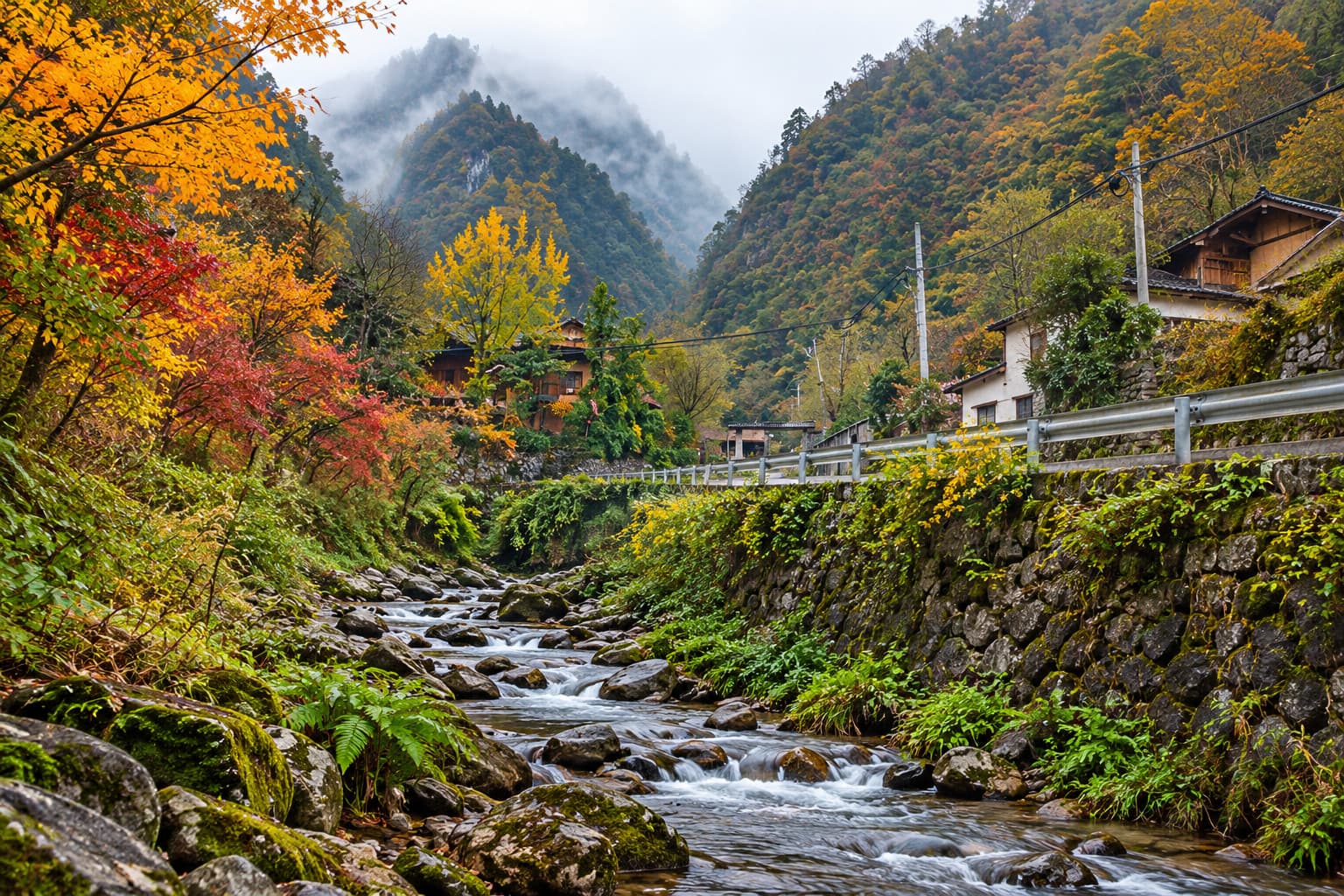
AI illustration based on a historical photograph. Dong’an mountain-town stream and ordinary roadside setting; this is a separate place context. Scene, terrain and architectural details are approximate; not a current photograph, access confirmation or navigation guide.
Historical reference only; original photograph not republished or licensed for reuse: iChongqing / Photographer not credited
Verify the room as carefully as the landscape
The county’s April 2026 Kanggu profile describes a range of accommodation and leisure facilities across the resort. It does not establish that every forest homestay has the same facilities, language support or accessibility. Translate an attractive area description into questions about the specific room you can book.
Ask about bathroom arrangements, heating or cooling for your dates, bedding, hot water and any stairs between the vehicle and room. If a lift or step-free entrance matters, ask whether it serves your actual building and floor. Request a current photograph of the relevant entrance or bathroom if the written answer is ambiguous. Do not infer the facilities of one room from a photograph of another category.
Tell the property which identity document you will present and ask it to confirm the check-in arrangement. This is a practical booking check, not a claim that a particular category of accommodation is legally closed to foreign visitors. Keep the property’s written reply with your reservation. Our foreign-passport hotel check-in guide provides wider context, but the room and host still need to be confirmed.
Clarify payment and cancellation before travel. Check which services are included and which require advance arrangement: meals, pickup, a local guide or an outing may be priced separately. If the booking involves a deposit, make sure the payee and terms match the provider you intend to use. A generous-sounding package is hard to compare until its contents are clear.
Keep nature outings within confirmed public access
A 2025 Land journal study of Dong’an settlements describes the close interweaving of ecological space, agriculture and village buildings, with terrain and conservation constraints shaping development. This is research context, not a current trail permit or a recommendation to explore the study area independently.
Ask your host or the attraction operator to identify a permitted outing that matches the weather, your ability and your available transport. Be specific about whether you want an easy village stroll, a managed scenic route or a more demanding guided activity. A distant ridge visible from the room is not automatically reachable by a public path, and a line on a general map does not prove that a route is maintained.
For a modest walk, agree on the start, the intended turnaround and the return contact. Ask which sections are public and whether any path is closed. Stay out of cultivated land, forestry working areas and restricted conservation zones. Avoid following an informal streambed or an unmarked shortcut because another traveller posted an attractive photograph there.
Do not let the phrase “nature stay” pressure everyone into hiking. Sitting in a permitted public space, looking at the valley and taking a short agreed walk can be a complete day. If weather warnings or local restrictions rule out the planned outing, use the accommodation as a base for rest or leave when travel is safe. This article does not supply off-trail navigation or a substitute for local conditions.

AI illustration based on a historical photograph. Close exterior detail of woven panels, timber framing and glazing on the documented Xingtian guesthouse, approximately reconstructed; no author stay, interior amenities or private access is claimed. Scene, terrain and architectural details are approximate; not a current photograph, access confirmation or navigation guide.
Historical reference only; original photograph not republished or licensed for reuse: iChongqing / Photographer not credited
Set a pace that suits a village stay
The 2026 destination profile presents Kanggu as a multi-season destination. That description should not be read as a weather guarantee or as proof that every activity operates throughout the year. Choose the dates around what you hope to do, then confirm that activity and the road approach separately.
A useful stay has room for arrival, an unhurried local day and an uncomplicated departure. That is a planning principle rather than a minimum-night rule. If the available travel window leaves no time to enjoy the base, a closer destination may be a more satisfying choice. Do not count hours on a transport booking as time already spent in the forest.
Before an early departure, settle the breakfast and pickup arrangements while the host is available. Check that your onward connection leaves enough margin for the road journey as the provider currently expects it. Keep the address and contact details offline, and avoid relying on a single app screen for all the information needed to leave.
For photographs, look for the lived landscape: houses meeting a slope, cultivated ground beside a lane and the mountain setting beyond. Ask before entering fields, using a courtyard as a backdrop or making a resident the focus. Our maps and navigation guide can help with place identification, but local permission and present conditions determine where you should go.
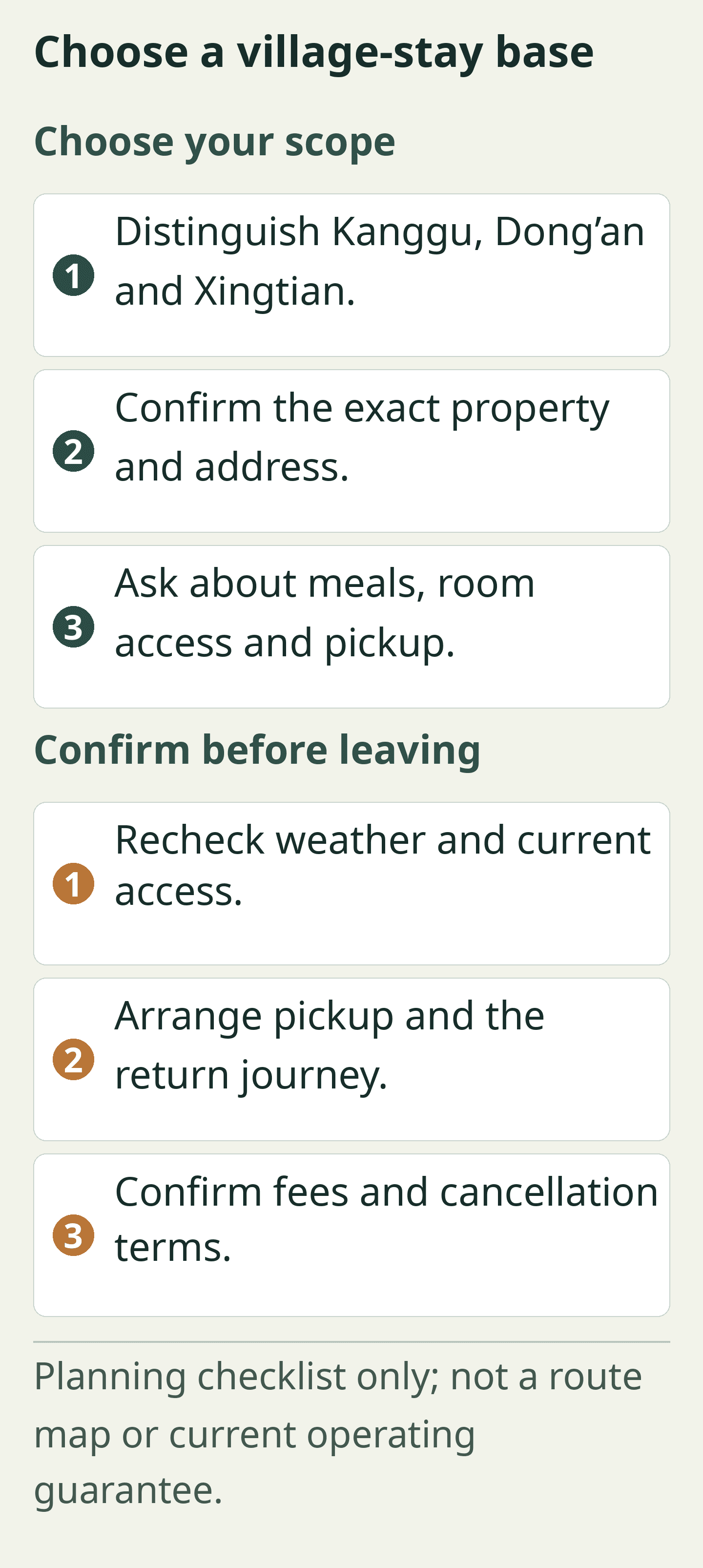
Original editorial planning diagram based on this article; not a photograph or geographic map. Planning checklist only; not a route map or current operating guarantee.
Original editorial planning diagram based on this article; not a photograph or geographic map.
Choose a village-stay base
Choose your scope:
- Distinguish Kanggu, Dong’an and Xingtian.
- Confirm the exact property and address.
- Ask about meals, room access and pickup.
Confirm before leaving:
- Recheck weather and current access.
- Arrange pickup and the return journey.
- Confirm fees and cancellation terms.
Planning checklist only; not a route map or current operating guarantee.
About This Guide
Public sources were read on 1 October 2026, including the county’s Kanggu profile, recent municipal reporting, an older field feature and the relevant study-area section of a research paper. No accommodation, transfer or walk was tested. The guide distinguishes destination facts from property-specific and visit-date questions, and does not recommend unverified wilderness routes.
Frequently Asked Questions
Q: Where should I start looking for a Chengkou village stay? A: Xingtian village in Dong’an town is a documented base for the Kanggu tourism area. Confirm the individual property’s exact location, room, meal arrangements and pickup before treating a broad “Chengkou” listing as suitable.
Q: Can I take a high-speed train directly to Chengkou now? A: The July 2026 municipal report still describes the Chengkou section of the Xi’an–Chongqing railway as a future 2028 opening. Check the actual railway booking system for your date and do not use old construction forecasts as a timetable.
Q: Does a Daba Mountains forest homestay include meals and transport? A: Those inclusions are property-specific and were not verified across Chengkou. Ask the host to itemise the room, meals, pickup and any guided activities before comparing packages or paying a deposit.
Q: Can I hike anywhere around Kanggu? A: No general access permission is established by the Kanggu tourism designation. Ask for a currently open public route or an authorised guided outing, and avoid private farmland, working forestry areas and restricted conservation zones.
Q: Is the whole Kanggu area at the same altitude? A: No. Chengkou’s April 2026 profile gives the scenic area a broad 1,100–2,680-metre elevation range. Confirm the location and conditions of your actual accommodation and outing rather than applying one mountain figure to the whole stay.


Traveler comments
Share a recent experience or ask a practical question about this guide.